Do you know Poutine?
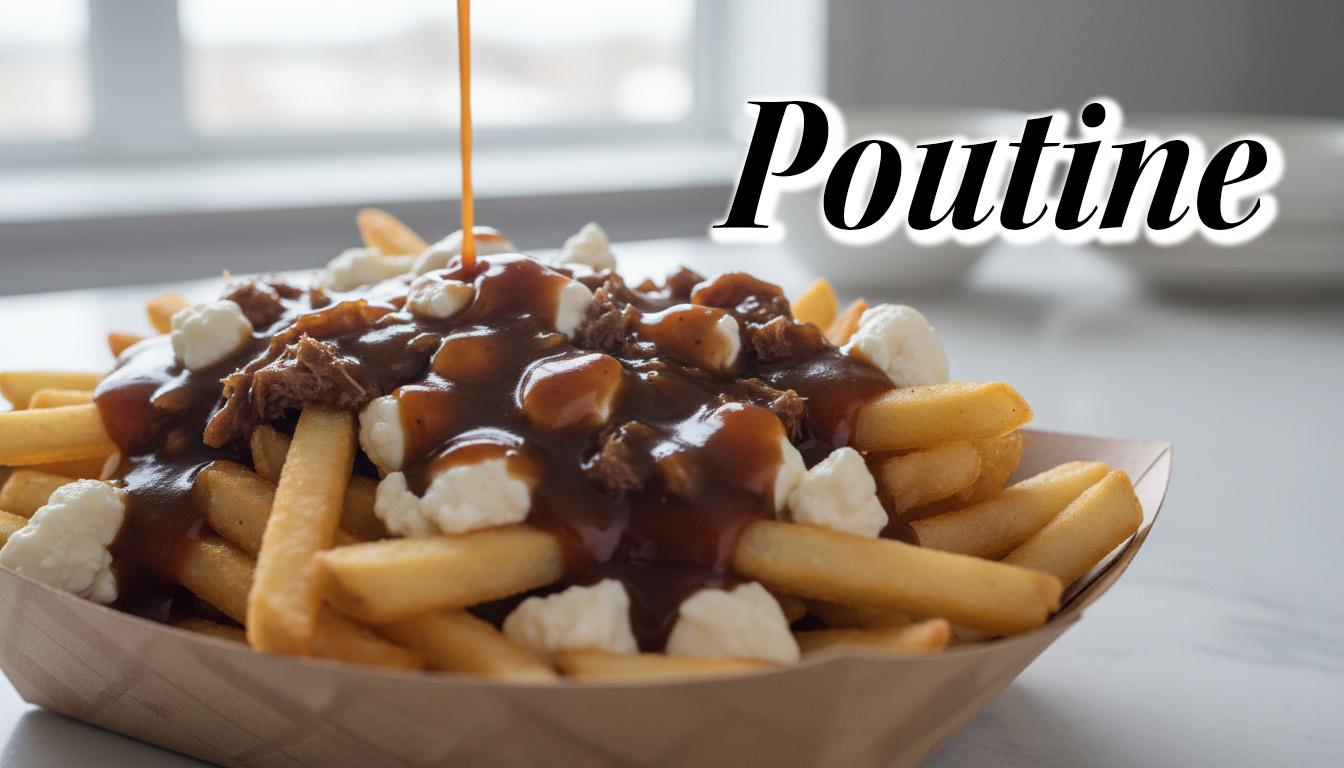
Poutine is a type of Canadian junk food featuring French fries as its main ingredient.
Its rich flavor is beloved by Canadians, and it has been cherished culturally as well.
And that junk food will capture the stomachs of many people and spread.
This article will introduce everything about Poutine—from its history and culture to how it's made!
Please watch until the very end!
~Notice~
This site introduces cuisines from around the world and also features songs that express those dishes.
You can also listen on YouTube and various subscription services, so please give it a listen!
We've also started accepting requests for music production!
Perfect for personal use or in-store background music!
We offer a wide range of services, from existing dishes to original creations, so feel free to place your order anytime!
What kind of dish is Poutine?
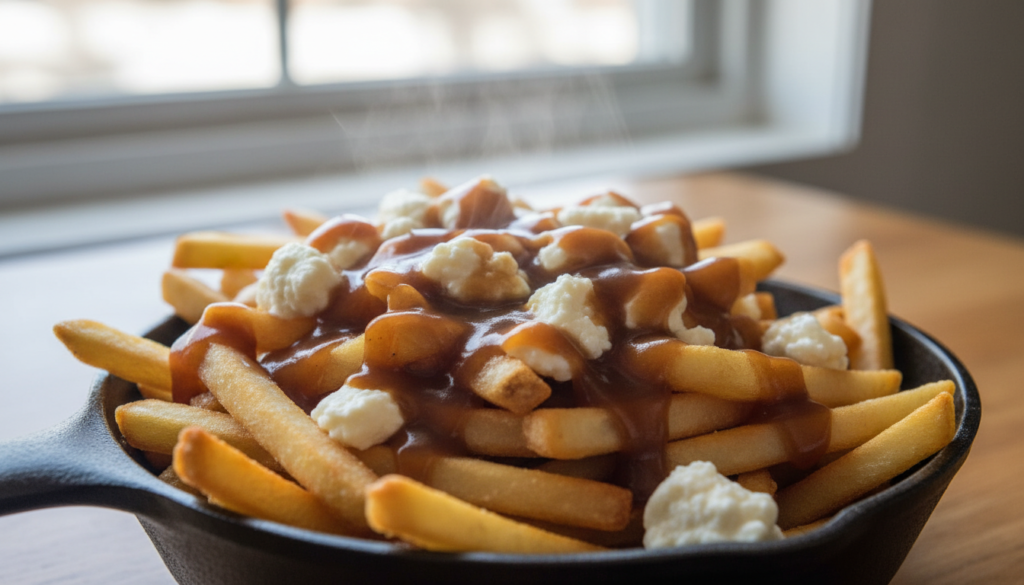
Poutine is one of the dishes originating in Canada.
A simple dish centered around French fries, it's the quintessential junk food offering an incredibly high level of guilt and satisfaction.
Its origin is said to be in Quebec, Canada, and from there it spread throughout Canada and is now served in northern America and tourist restaurants.
It's a dish that, despite being junk food, has become beloved to the point of being considered a national dish.
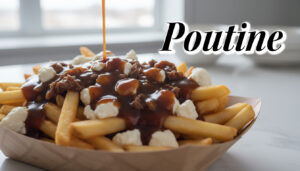
Poutine is a dish made with french fries topped with cheese curds and_ gravy.
Cheese card is a type of fresh cheese that is eaten with little to no aging.
Card refers to curd, which is milk coagulated using acid or bacteria.
It is shaped like small stones rather than squares, and its uses are diverse, ranging from being eaten as is to being used in cooking.
When drizzled over crispy fried potatoes, it melts perfectly, adding a mild flavor and a satisfyingly chewy texture.
Another type of gravy is a sauce made from the juices rendered from meat.
The rich umami of the meat is concentrated, resulting in a deep, savory flavor with a rich aroma.
Therefore, Poutine has an overall flavor that is extremely salty and rich.
Poutine's History
As mentioned earlier, Poutine was born in the Canadian province of Quebec.
However, its exact origins remain unknown, with only several theories existing.
Therefore, this time I will introduce two of the most commonly discussed theories.
The Origins of Poutine
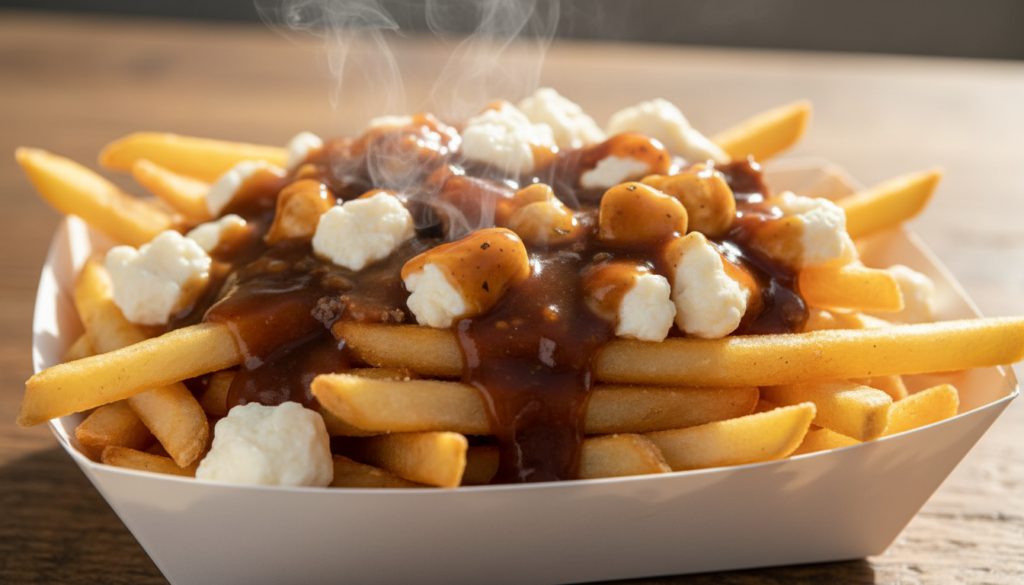
The first is the “Le Lutin qui rit” theory.
One theory traces the origin to 1957, when restaurant owner Fernand Lachance placed cheese curds on French fries at the request of a regular customer.
The famous anecdote is that Lachance said, “Ça va faire une maudite poutine!” (This is going to be a hell of a mess!).
It is said that the current form came about when hot gravy sauce began to be poured over the food, which had previously been served in paper bags to keep it warm.
The second theory is the “Le Roy Jucep” theory.
The owner of the drive-in restaurant “Le Roy Jucep,” Jean-Paul Roy, had been serving a dish of french fries topped with sauce since around 1958.
Upon seeing customers adding cheese cards themselves, it was officially added to the menu in 1964.
It is said that the dish was originally named “fromage-patate-sauce,” but later came to be known as “poutine.”
While various theories exist due to multiple regions claiming its origin, they all agree that it originated in the Quebec region in the late 1950s.
Poutine's Development
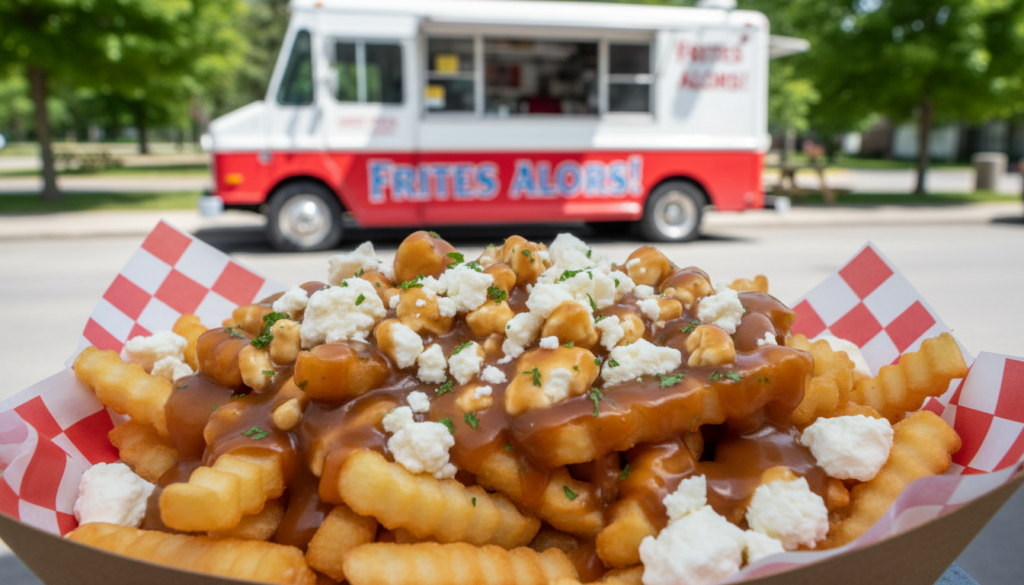
After that, Poutine spread as a popular local dish at small Quebec diners, chip trucks, and_ pubs.
At this time, it was not yet a national dish, but rather a popular snack food within Quebec province.
However, by the 1980s to 1990s, fast-food chains across Canada began offering Poutine, leading to its widespread recognition.
For example, around 1972, Burger King introduced it to its menu in Quebec.
Around 1990, McDonald's added it to its Quebec menu, and its popularity grew as it was subsequently rolled out across Canada.
In the 2000s, even high-end restaurants began serving Poutine as a dish.
Variations featuring ingredients like foie gras and_ lobster have emerged.
This marked the beginning of Poutine's evolution from mere junk food to an iconic symbol of Canadian cuisine.
Fun Facts and Interesting Stories About Poutine
① The correct answer is that cheese doesn't melt.
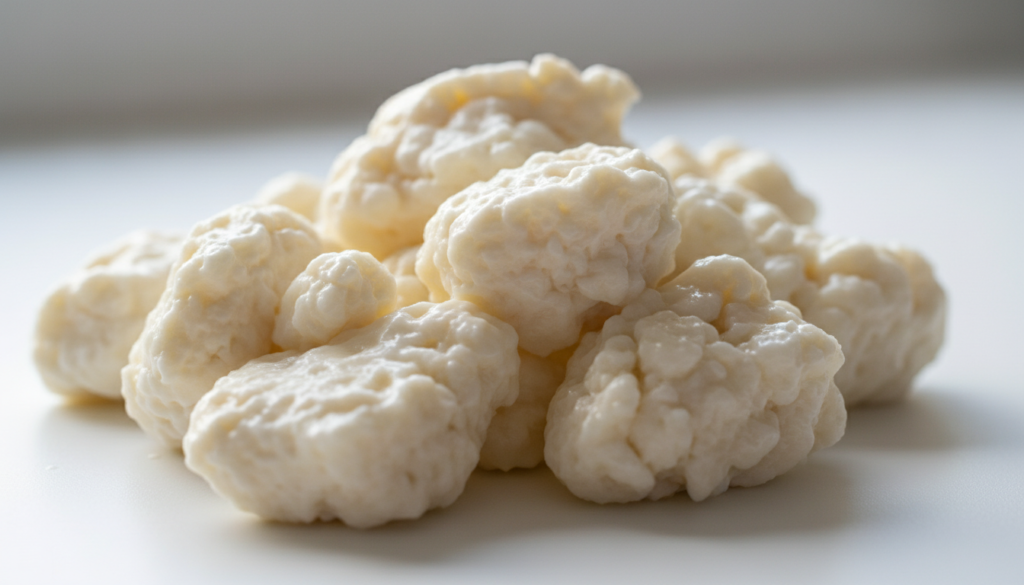
The cheese card used for Poutine is considered ideally not to melt completely.
- The outside warms up and softens slightly.
- Inside is springy and_ makes a squeaking sound.
This “crispness” is considered crucial in its place of origin, and_ cheese that melts too much is regarded as a failure.
② There was a time when it was seen as “tourist food” in Quebec.
While it is now a national dish, until around the 1980s, Poutine was
“Cheap snacks from the countryside” “Tacky food”
As such, it was sometimes shunned by urban areas and the educated class.
Now, however,
- High-end restaurant
- International Event
- Canadian national dish
It's interesting that it has been upgraded to that level.
③ A debate arises over whether it's “authentic Poutine.”
In Canada, this kind of debate often arises.
- Can mozzarella be used as a substitute?
- Is gravy sauce okay with chicken?
- Are the potatoes cut into thin strips? Or thick slices?
These naturally vary by region and personal preference, but the thickness of the potatoes remains an eternal topic of discussion.
Especially in Quebec
“It's not Poutine unless it has cheese curds.”
Many people claim that.
④ Poutine is sometimes used as a political and cultural symbol.
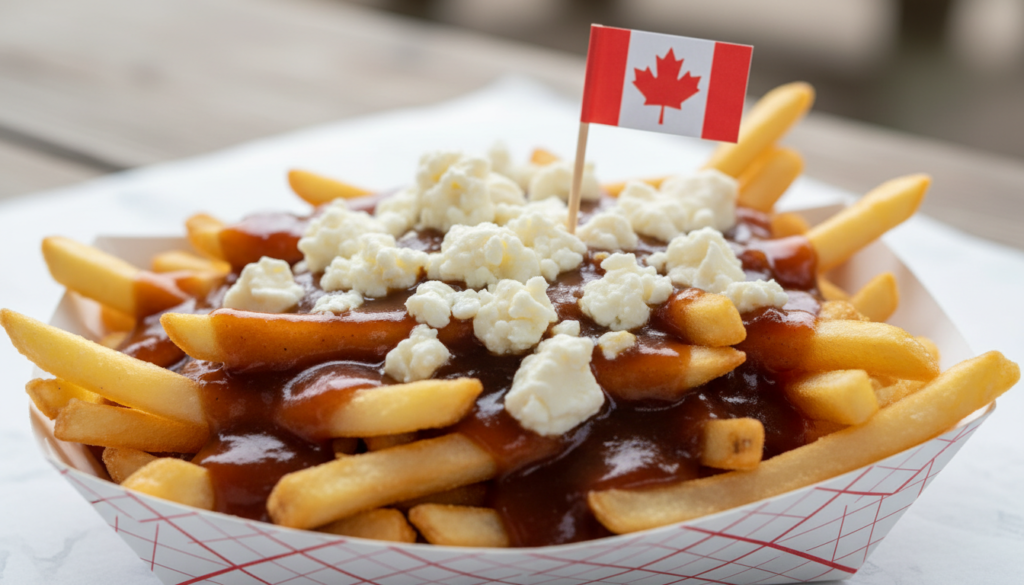
Poutine is sometimes treated as a dish symbolizing Quebec culture and_ Francophone identity.
Content symbolizing Canadian federalism and multiculturalism may also appear in media and political satire.
In other words,
“It's just a potato dish, yet it carries such heavy cultural significance.”
It is a rare junk food that carries such significance.
⑤ The name means “chaos and mess.”
The word poutine, which also forms the origin of the term, is Quebec slang meaning “a jumble” or_ “a mess”.
Just as the dish looks,
- “Looks messy but tastes great.”
- “The charm lies in the lack of order.”
This is also seen as characteristic of Poutine.
How to Make Poutine
Ingredients (for 2 people)
- Potatoes (Meikun or Baron)… 3–4 pieces
- Fresh cheese curds... approximately 120g
- Cooking oil … as needed
Gravy
- Beef or chicken broth... 250ml
- Butter … 20g
- Flour … 1 tablespoon
- Salt and black pepper … to taste
How to make them
- Cut the potatoes
Cut into thick sticks with the skin left on. - double-fry
- Fry once at 160°C (cook through to the center)
- Double-fry at 180°C (for a crispy exterior)
- Make gravy
- Make a roux with butter and flour
- Gradually add the flour to thicken the mixture.
- Season with salt and pepper
- Presentation
- Hot potatoes
- Place the cheese card
- Pour warm gravy over the top.
Tips for Making It Delicious (Important)
- Always keep the sauce warm.
- Potatoes should be crispy (No moisture allowed)
- Don't overdo the cheese (it makes it heavy).
Easy-to-make substitutes for Poutine in Japan
Use frozen French fries
Use mozzarella cheese instead of cheese cards
Store-bought beef stew or demi-glace sauce as a substitute for gravy
These substitutes are recommended for their availability and ease of preparation.
On the other hand, there are drawbacks such as the lack of that authentic “crisp” texture unique to the original, or_ the fact that it's not considered “orthodox.”
However, while the texture is different, it's still perfectly fine and recommended for getting to know Poutine.
Summary
How was it?
This article introduced Canada's iconic junk food, Poutine!
It was a rare dish that offered both the satisfaction and guilt associated with junk food, while also holding significant cultural meaning!
When you're hungry, enjoy a quick and easy meal with alternatives!
Just be careful not to get burned by oil or_ anything like that.
Thank you for watching until the very end!
And if you'd like, please check out our other articles too!
Comments