
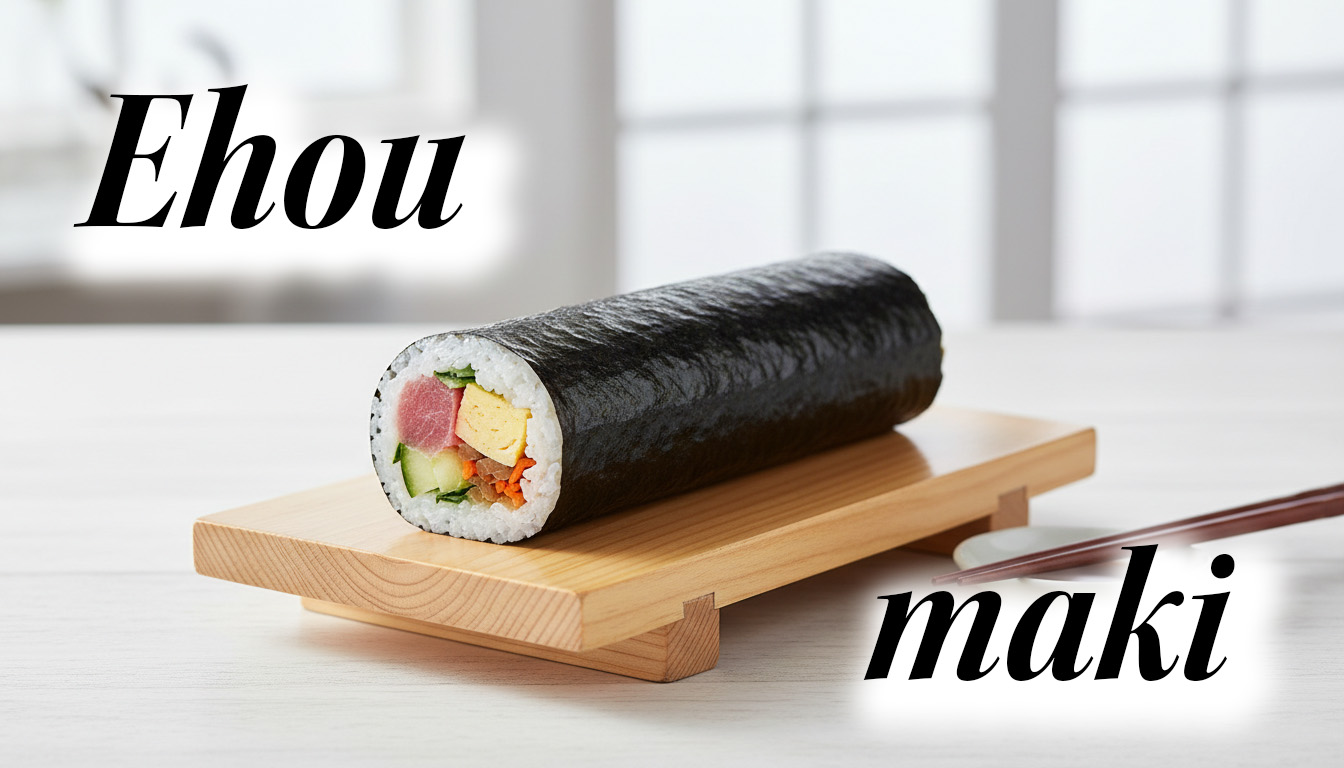
Have you ever eaten an Ehoumaki?
Ehoumaki is a type of rolled sushi with a somewhat unique cultural tradition surrounding how it is eaten.
And I believe it's also an interesting cuisine that adapts to the modern era while preserving its inherited traditions, presenting itself in various forms.
Now, in this article, we'll cover everything about Ehoumaki—from its origins and history to how to make it.
Please watch until the very end!
~Notice~
This site introduces cuisines from around the world and also features songs that express those dishes.
You can also listen on YouTube and various subscription services, so please give it a listen!
We've also started accepting requests for music production!
Perfect for personal use or in-store background music!
We offer a wide range of services, from existing dishes to original creations, so feel free to place your order anytime!
Click here for our guide page!
↓↓↓↓↓↓↓↓↓↓↓↓↓↓↓↓↓↓
What exactly is an Ehoumaki?
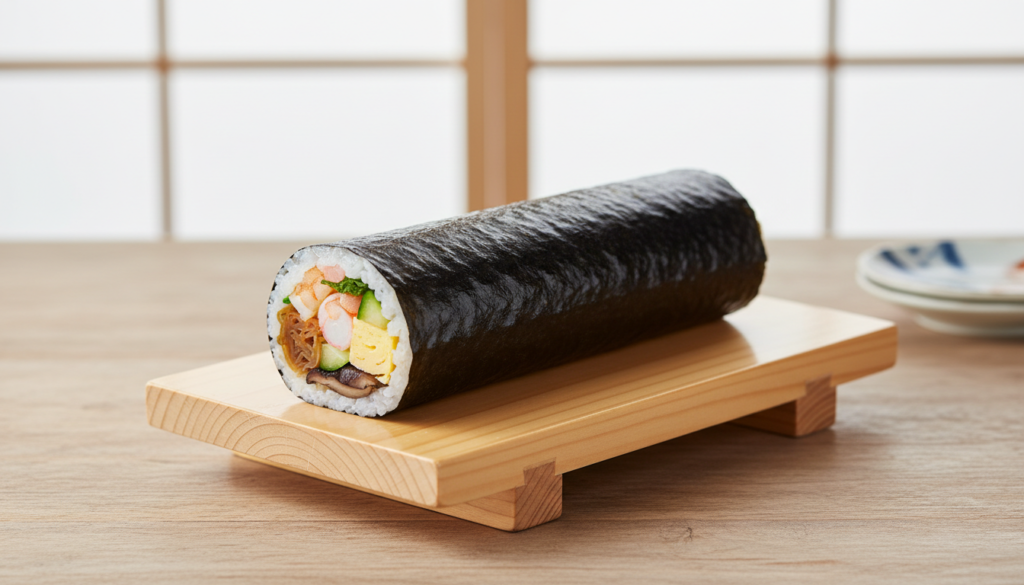
Ehoumaki is a type of thick rolled sushi popular in Japan.
The most notable feature of this dish lies in how it is eaten.
Ehoumaki are eaten on Setsubun Day, the day before the start of spring.
Without cutting it, eat the entire Ehoumaki sushi roll in one go, facing the lucky direction known as the Ehou and_ without speaking.
It is said that doing so signifies “taking in good fortune all at once” and_ “keeping good connections unbroken.”
Ehoumaki rolls typically contain seven types of ingredients.
Examples include rolled omelets, cucumbers, dried gourd strips, shiitake mushrooms, eel, and conger eel.
This is because the seven ingredients are considered auspicious items associated with the Seven Gods of Fortune.
The Seven Gods of Fortune are deities of good fortune originating from the Buddhist phrase “Seven Calamities Immediately Vanish, Seven Fortunes Immediately Arise,” which was introduced from India.
The seven deities—Ebisu, Daikokuten, Fukurokuju, Bishamonten, Hotei, Jurojin, and Benzaiten—are famous, aren't they?
However, with the recent widespread adoption of the Ehoumaki culture, a wide variety of fillings have also begun to appear.
Seafood varieties featuring tuna and salmon, as well as modern adaptations with cheese and mayonnaise-based seasonings, have evolved in both form and flavor over time.
The Origin and History of Ehoumaki
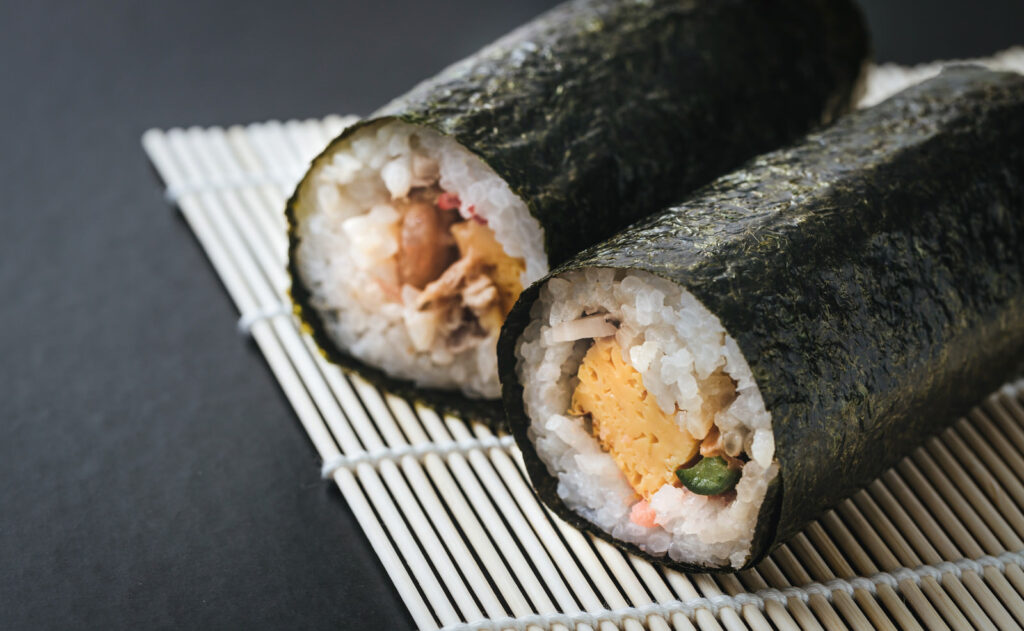
While Ehoumaki rolls are now eaten throughout Japan, many aspects of their origin and history remain unclear.
Multiple theories of origin and the circumstances surrounding its spread throughout the country have combined to create the Ehoumaki we know today.
The most widely accepted theory dates back to the Edo and Meiji periods (approximately the 17th to 19th centuries).
In Japan's Kansai region (including Osaka), it is said that there was a custom of eating thick rolled sushi.
It was done with the meaning of “eating it whole as a symbol of good fortune,” which connects to the modern practice of eating Ehoumaki.
At the time, it was called “marukaburi sushi,” “fat roll sushi,” or “marukaburi sushi.”
Thick rolled sushi, which incorporates seaweed and fillings, was itself enjoyed as a regional custom.
Another theory suggests that warlords of the Sengoku period would eat whole sushi rolls whole to pray for victory.
There is a theory that during the Edo period, courtesans in Osaka's pleasure quarters enjoyed eating whole sushi rolls as part of their entertainment.
The Popularization of Ehoumaki
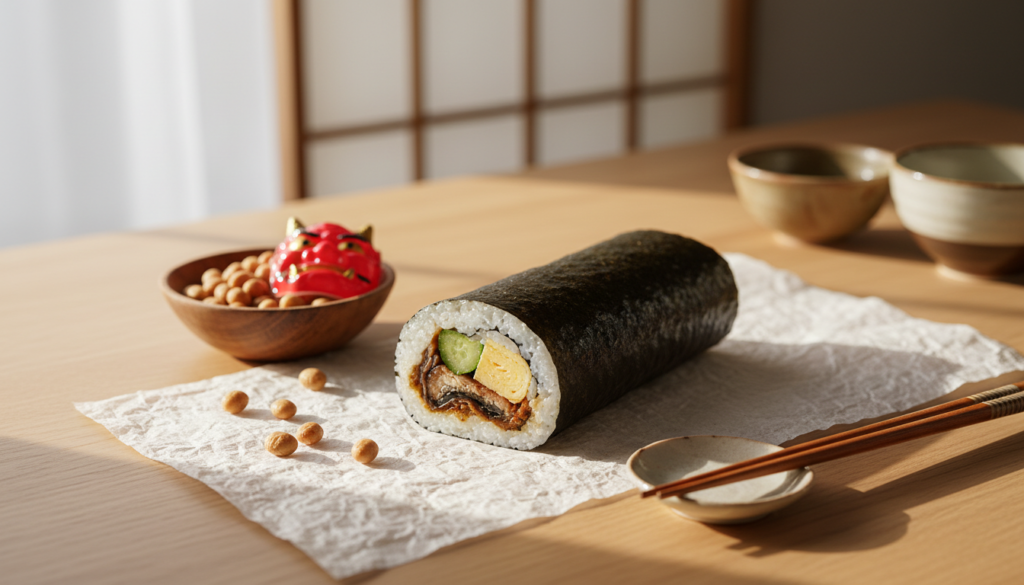
Around 1930, it has been confirmed that the Osaka Sushi Industry Association and others conducted a PR campaign promoting the idea of eating a whole rolled sushi at once during Setsubun.
This was conducted as part of promotional and event-related activities.
However, it is said that this custom was once abandoned due to the war.
Later in the 1970s, supermarkets and the nori industry in Osaka began promoting Ehoumaki as a sales tactic.
This event sparked a renewed spread of the Ehoumaki culture throughout the Kansai region.
By 1989, convenience stores like 7-Eleven began selling thick rolls for Setsubun under the name Ehoumaki.
This gained popularity and by the 2000s, it was being promoted nationwide.
Through advertising, media exposure, and sales campaigns by convenience stores and supermarkets, Ehoumaki spread throughout Japan as a standard seasonal food for Setsubun.
Nowadays, the image of “Setsubun = Ehoumaki” has become commonplace.
Fun Facts and Interesting Stories About Ehoumaki
① “The seven types of ingredients” is not actually a strict rule.
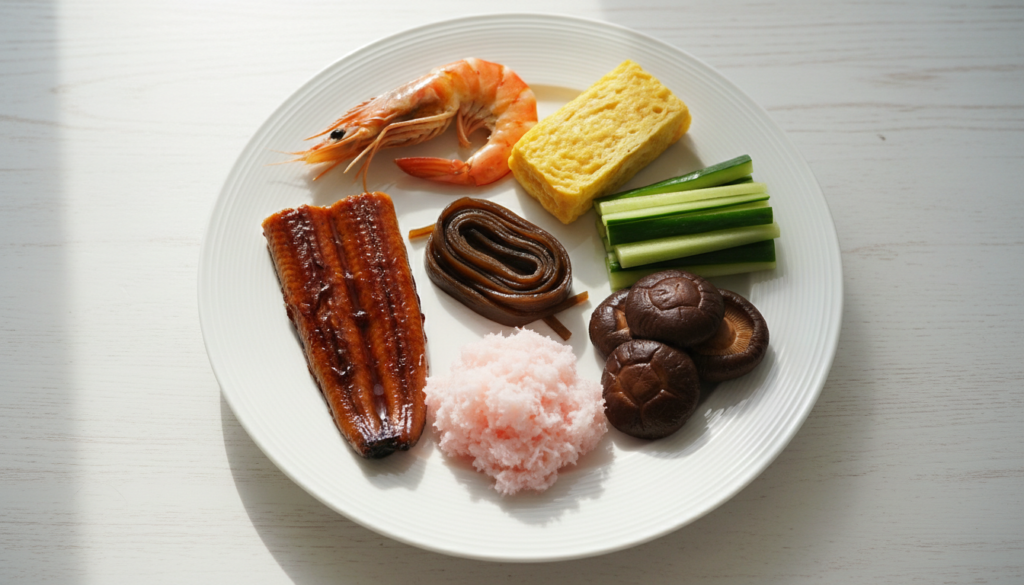
Traditionally, Ehoumaki rolls often contain seven types of ingredients.
This is a guideline inspired by the Seven Lucky Gods, not a fixed list of ingredients.
Recently, there has been greater freedom in combining ingredients.
② The direction changes every year.
The direction to face when eating Ehoumaki, known as the “Ehou,” changes every year.
This is based on divination philosophies such as Onmyōdō, where the auspicious direction is determined according to the zodiac sign of the year.
For example, in 2026, the southeast direction is the lucky direction.
③ Challenging the Guinness World Record!
In 2025, during Setsubun, a Japanese supermarket chain challenged and achieved the Guinness World Record for the “Largest number of people eating Ehoumaki simultaneously.”
This is a large-scale event where 311 people face the lucky direction for that year and quietly eat thick sushi rolls.
This Guinness World Record provided a unique opportunity to promote the traditional Japanese custom of Ehoumaki both domestically and_ internationally.
Beyond being merely a “dining habit,” it is characterized by being valued as a cultural and community activity where many people simultaneously engage in the same action.
④ Unique sales approaches as corporate strategy
In recent years, convenience stores have released character-themed Ehoumaki, while department stores and supermarkets have offered giant-sized or premium-ingredient Ehoumaki for limited periods, diversifying the range of options available.
These items are popular as “auspicious items + seasonal limited-edition products.”
⑤ At the intersection of food culture and contemporary challenges
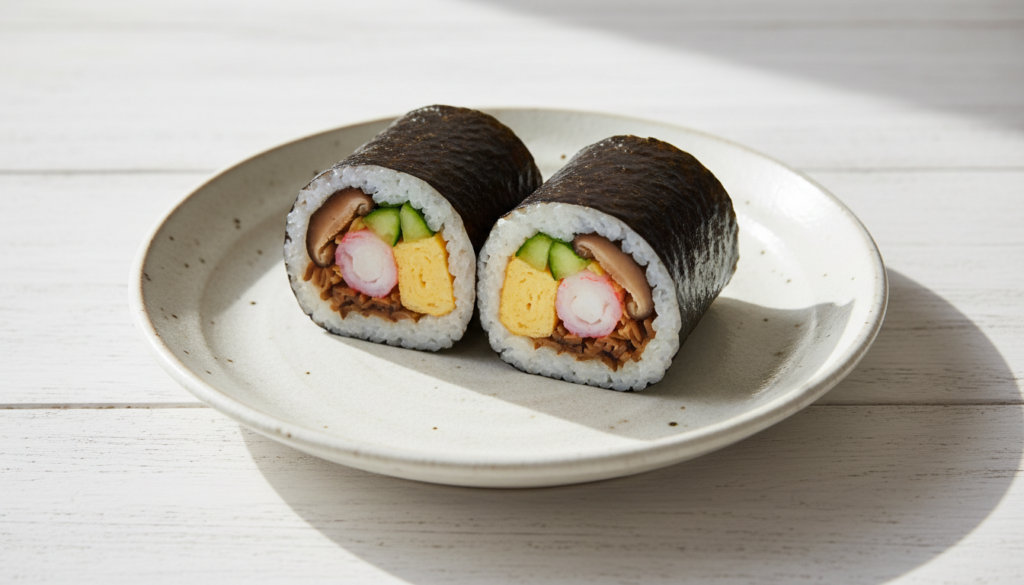
Ehoumaki has also become a subject of debate surrounding food waste (the issue of discarding uneaten Ehoumaki).
A particular challenge is that Ehoumaki rolls, with their short shelf life, are prone to being discarded, especially due to the impact of pre-order sales and mass production.
In contrast, in recent years, initiatives to reduce food waste have also expanded, including strictly enforcing reservation systems, introducing half-size products, and_ encouraging home cooking.
Ehoumaki can be seen as a symbolic food culture where traditional customs intersect with modern dietary concerns.
How to Make Ehoumaki
Materials (1 set)
Basic Ingredients
- Rice: 1 cup
- Sushi vinegar: 2 to 3 tablespoons
- Roasted seaweed (full sheet): 1 sheet
Ingredients (either is fine)
- Classic Style: 7 Toppings
- Free-style: Your choice of fillings (3–7 types are easiest to roll)
The key is to cut the ingredients into thin, long pieces of uniform length to prevent them from becoming too thick.
How to make them
① Make sushi rice
- Cook the rice slightly firm.
- Pour the sushi vinegar over while it's hot.
- Cut through the mixture while stirring, then cool it with a fan.
The ideal state is not sticky, with grains standing apart.
② Prepare the ingredients
- Cut everything slightly shorter than the width of the nori.
- Thoroughly pat dry with paper towels.
Doing this carefully makes the rolling process much easier.
③ Preparing to roll
- Place the nori sheet on the bamboo mat (shiny side down)
- Spread the sushi rice
- Leave a little space in front, and don't spread it too far back.
Guideline: The thickness of the rice should be about 7–8 mm
④ Place the filling and roll (Important Point)
- Arrange the ingredients in a single horizontal row slightly toward the front rather than the center.
- Press down the filling from the front while rolling it up in one swift motion.
- Lightly shape the ends after rolling.
The trick is not to overdo it.
Place it with the rolled end down for about one minute to stabilize.
⑤ Not cutting it is the way to go for Ehoumaki.
- The basic rule for eating Ehoumaki is to eat the entire roll without cutting it.
- When cutting for home use or photography,
- Wet the knife
- Pull back sharply and cut
Approach to Ingredients
Standard approach
We balance sweet, salty, refreshing, and texture.
- Sweet-style: Tamagoyaki, sweet-simmered shiitake mushrooms, etc.
- Umami-rich: conger eel, eel, fish cake, etc.
- Refreshing flavors: cucumber, mitsuba, etc.
- Texture: Dried gourd strips, cherry blossom-flavored fish flakes, etc.
For your choice of ingredients
Keep the following in mind to make winding easier:
- Not too much moisture
- The thickness is uniform.
- Limit strong-flavored ingredients to one or two types.
(Examples: Seafood, salad dishes, grilled meat, tuna mayo, etc. are also acceptable)
Summary
How was it?
This article introduced Ehoumaki, the lucky direction rolls eaten nationwide in Japan during Setsubun!
It was a slightly unusual dish where you eat facing this year's lucky direction without speaking.
In recent years, while maintaining tradition, various adaptations such as Ehoumaki rolls have emerged, making them more popular with a wider audience.
Whether you live in Japan or not, please try making and eating your own version of Ehoumaki!
I hope more people can experience this culture in a fun and delicious way!
Thank you for watching until the end.
If you'd like, feel free to check out some of our other articles!
Comments