

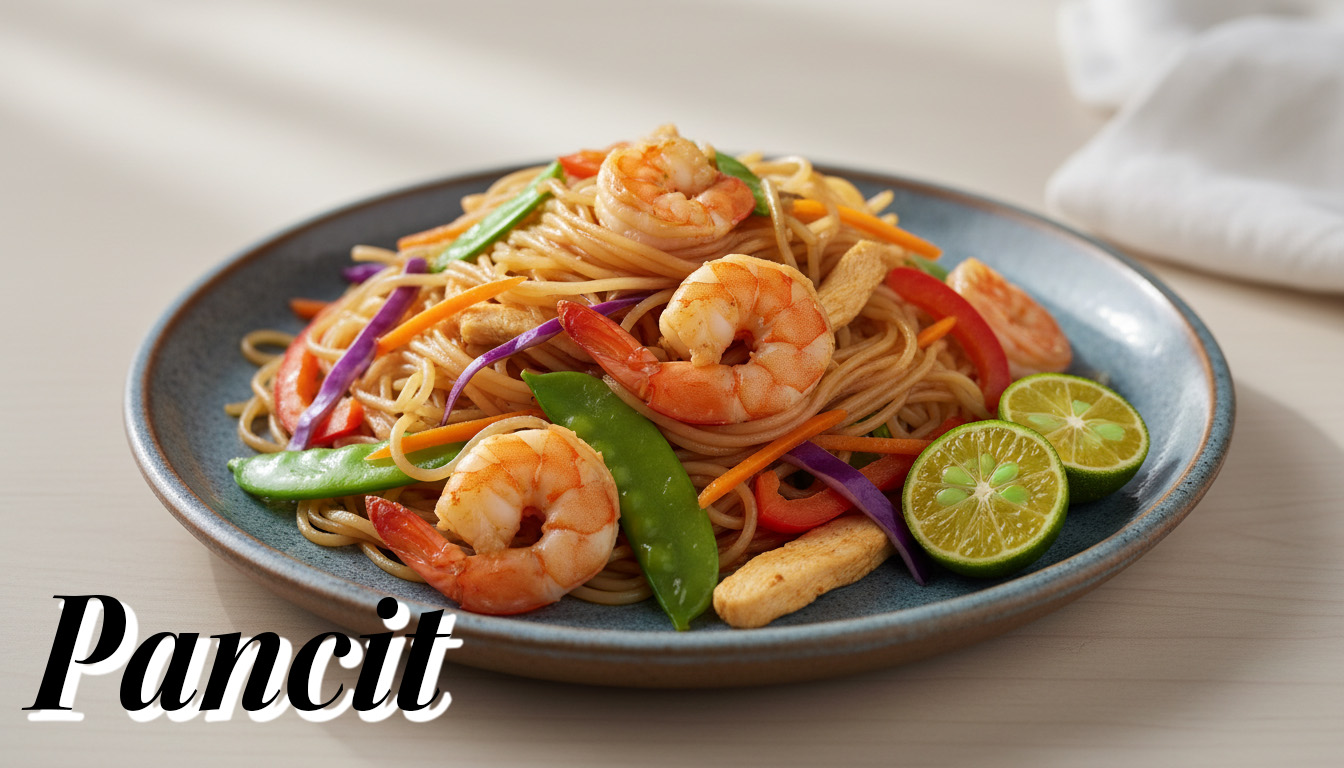
Do you know a dish called pansit?
This dish is always served at the table on Christmas and special occasions.
However, that dish isn't the star of the feast.
Even so, the dishes that remain staples on our tables are imbued with diverse sentiments and cultural traditions.
This article will cover everything about pansit, from its history to how it's made!
Please watch until the very end!
~Notice~
This site introduces cuisines from around the world and also features songs that express those dishes.
You can also listen on YouTube and various subscription services, so please give it a listen!
We've also started accepting requests for music production!
We also create original music to complement our dishes and provide in-store background music. Feel free to request our services anytime!
What is pancit?

Pancit is a noodle dish that represents Filipino cuisine.
There are many varieties depending on region, household, and occasion, and they are especially common at celebrations and Christmas gatherings.
The name is said to derive from the Fujianese Chinese phrase “pian i sit” (meaning “something that can be cooked immediately”).
The Philippines has maintained cultural exchanges with China for centuries.
Therefore, even in such food cultures, you can sometimes sense Chinese cultural influences.
This style of Pancit cooking involves stir-frying ingredients like vegetables, meat, and seafood together with the noodles.
Depending on the variation or region, it seems they also boil it rather than just stir-frying it.
It is similar to yakisoba or champon, but the ingredients and seasoning are unique to the Philippines.
The taste and flavor of Pancit vary across the Philippines, so it's hard to generalize.
However, as a general trend, many dishes tend to have a lighter flavor profile than Japanese or Chinese cuisine, often using soy sauce, onions, and fish sauce (patis).
The ingredients include meat, vegetables, and seafood, but the true appeal lies in the cooking techniques and flavors that enhance their natural umami.
Additionally, citrus fruits are often added as a finishing touch to enhance the acidity, and the distinctly Filipino flavor profile is another key point.
The History of pancit
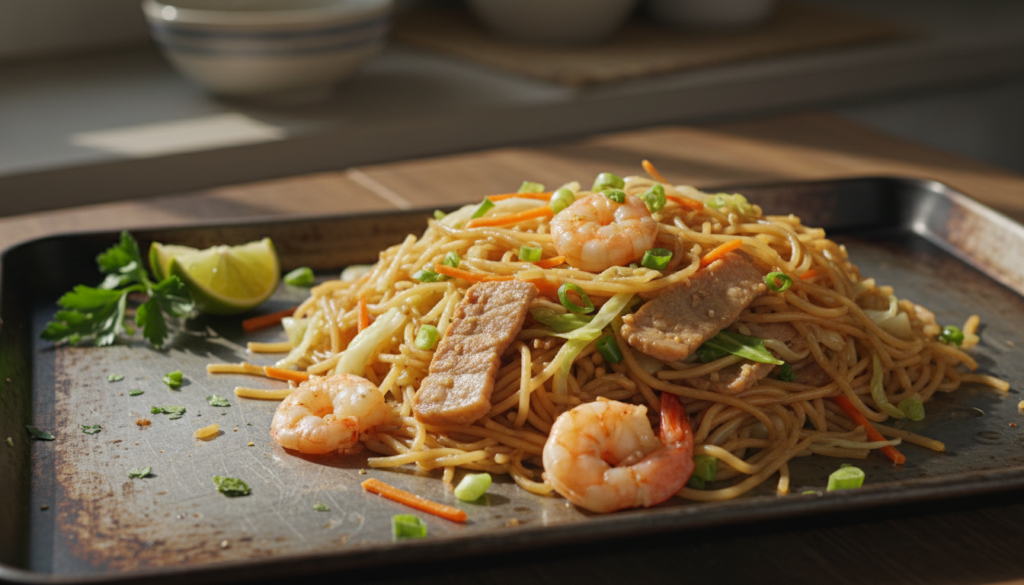
It is said that the prototype of Pancit is a Chinese noodle dish.
The Philippines has long been considered a key hub for maritime trade, and various cultures were introduced from China.
This included noodle dishes and cooking techniques that would later become the prototype for Pancit.
However, at this point, it was apparently positioned as foreign cuisine available in port towns.
By the 16th century, the Philippines came under Spanish rule.
This event led to Chinese immigrants (overseas Chinese and Sangley) settling in the area.
They were active as merchants and artisans, among other professions, and among them were cooks.
Thanks to that chef, Chinese restaurants and food stalls proliferated, and noodle dishes became widespread among the common people.
Therefore, during this era, dishes like Pancit, lumpia (spring rolls), and_ siopao (steamed pork buns) became firmly established as everyday foods.
After the 18th century, Pancit gradually evolved into a distinct part of Filipino cuisine.
- Not only wheat noodles but also rice noodles (bihon) are used.
- Combined use of soy sauce and fish sauce (patis)
- Served with calamansi (citrus)
- Use oil and spices sparingly.
As a result of these changes being made,
A Filipino-style noodle dish that isn't as greasy as Chinese cuisine, emphasizing sourness and savory flavors
has undergone a unique evolution.
Fun Facts and Interesting Stories About pancit
① “Pancit” is a genre name
So far, we've been introducing Pancit, but Pancit is actually the name of a noodle dish category.
- Pancit Canton
- Pancit Bihon
- Pancit Malabon
- Pancit Parabok
There are dozens of varieties available.
Therefore, if you ask a Filipino, “Do you like Pancit?” they might respond with, “Which kind of Pancit?”
② The “Must-Have Dish” for Christmas
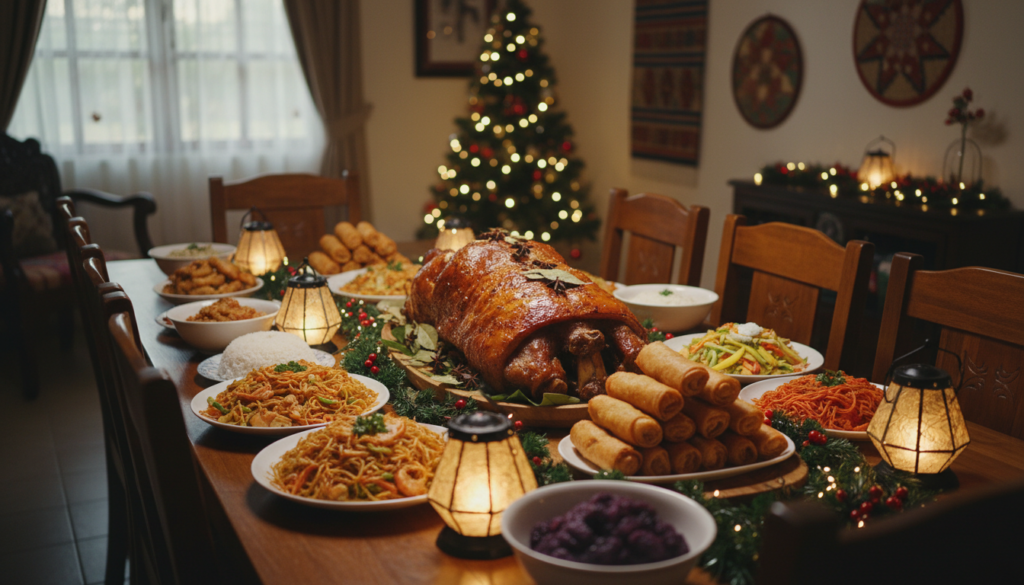
Pancit is not the main dish for Christmas.
Roast suckling pig takes center stage.
However, Pancit is cherished locally as a comforting staple that feels incomplete without it.
Reasons include its reputation as auspicious cuisine and its suitability as a connecting dish served on large platters.
Additionally, it pairs exceptionally well with Christmas as a dish symbolizing wishes for family health and good fortune in the coming year.
③ Pancit is an auspicious dish
Locally, Pancit is cherished as an auspicious dish.
The reasons include the fact that it is a noodle dish, its Chinese origin, and the ability to cook it cheaply and in large quantities.
The reason it is a noodle dish lies in the traditional belief that long noodles evoke longevity and prosperity.
Additionally, Pancit is a dish originating from China.
It is believed that when it was introduced from China, the concept of auspiciousness was also passed down at the same time.
For these reasons, it became a dish served at various celebrations, including Christmas and birthdays.
Some people even joke that “if you don't eat Pancit on your birthday, you won't live long.”
④ Differences in “Noodle Thickness”
The appeal of Pancit also lies in the variety of noodles.
Pancit Bihon, made with ultra-thin rice noodles (bihon), is a classic among classics.
It is eaten nationwide and is often called “the safest, foolproof Pancit.”
Pancit Canton uses medium-thick wheat noodles (canton).

It is commonly eaten on a daily basis, primarily in urban areas.
Additionally, its strong Chinese influence and generous toppings make it satisfyingly hearty.
Other dishes include Pancit Malabon, which uses thick noodles similar to udon.

This is a regionally distinct variation, eaten on holidays and special occasions.
Seafood is frequently used, allowing you to enjoy its rich flavor.
Pancit Recipe
Here, we introduce how to make Pancit bihon, the most common type of Pancit.
Ingredients (Serves 3–4)
Noodles・Main Ingredients
- Bihon (rice noodles, thin noodles)……200g
- Chicken thigh meat (or pork)……150g
- Shrimp (peeled)……100g
Vegetables
- Cabbage……2–3 leaves
- Carrot……1/2 medium
- Green beans (or leafy greens)……as needed
- Onion……1/2
Flavorings and Seasonings
- Garlic……2–3 cloves
- Soy sauce (Philippine soy sauce or Japanese dark soy sauce)……2 to 3 tablespoons
- Fish sauce (Pati)……1 to 2 teaspoons
- Black pepper……a pinch
Soup and oil
- Chicken broth (or water + a little chicken stock)……300ml
- Cooking oil……2 tablespoons
Finishing
- Calamansi (or lemon)……to taste
Preparation
- Soak the bihon in water
- Do not cook until completely soft; leave a slight firmness in the center.
- Meat should be cut into thin strips, vegetables should be julienned.
- Remove the vein from the shrimp.
👉 Locally, it's considered that the finer the cut, the more refined it is.
How to Make (Basic Steps)
① Sauté the aromatics
Heat oil in a frying pan (or wok),
- Garlic
- Onion
Sauté over low to medium heat until fragrant.
② Add the meat and shrimp.
- Add chicken (or pork) and cook through.
- Add the shrimp and remove them once they change color (to prevent them from becoming tough).
③ Soup + Seasoning
- Add chicken broth.
- Add soy sauce, fish sauce, and black pepper.
👉 “Get the flavor just right here” is the Filipino way.
The noodles will absorb the flavor later.
④ Add the bihon
Place the returned Bihon inside,
- Use tongs or chopsticks to stir the soup as if sipping it.
- Cook over medium heat until the liquid has evaporated.
⑤ Return the vegetables and shrimp
- Vegetables → Shrimp last
- Stir everything together just before turning off the heat.
👉 The standard approach is to keep vegetables crisp.
⑥ Plating
- Heaped high on a large platter.
- Serve with calamansi (or lemon).
How to Eat (Important Cultural Point)
- Squeeze the citrus just before eating.
- You can add extra vinegar or soy sauce during cooking.
- The basic practice is to serve portions individually.
Summary
How was it?
This time, we introduced the traditional Filipino noodle dish, Pancit!
Noodle dishes that crossed the sea have been passed down as a national food enjoyed daily, as well as on holidays and special occasions.
Pancit, which developed uniquely in the Philippines and underwent distinctive regional variations, is truly
“A single noodle dish encapsulates the history and family culture of the Philippines.”
I suppose you could say that.
It's easy to recreate using ingredients available in Japan, so please give it a try!
Thank you for watching until the end.
Feel free to check out our other articles too!

Comments