

Panettone is a tall, dome-shaped Christmas bread from Milan, Italy, leavened slowly with a natural sourdough starter and filled with raisins and candied citrus peel. Italians eat it at Christmas because the custom grew out of a medieval Milanese tradition of sharing one large loaf — and from early December until Epiphany on 6 January, it remains the centrepiece of the family table.
This article traces panettone’s origins and history, the tradition of its mother yeast, lievito madre, and a home-friendly panettone-style recipe you can bake yourself.
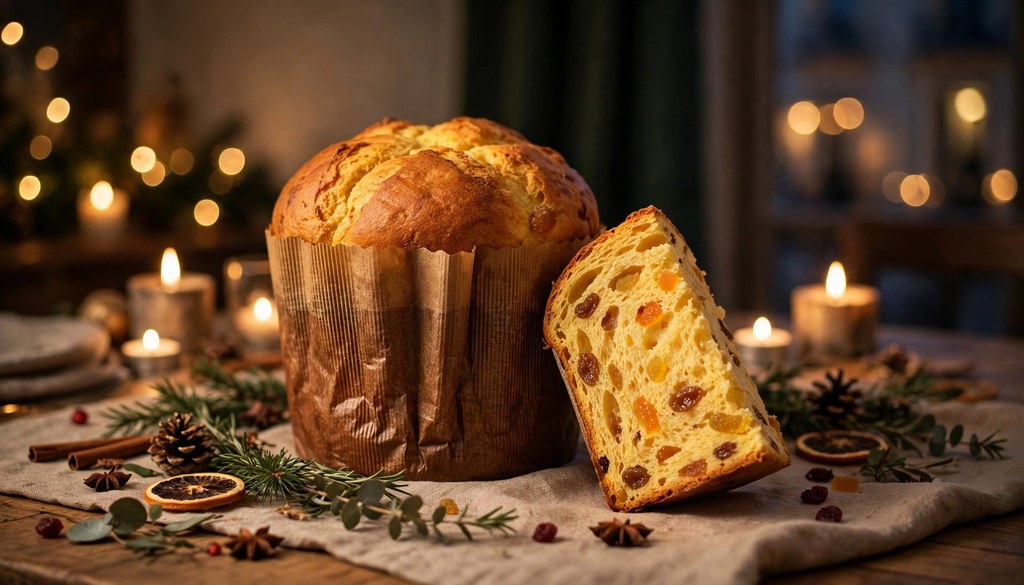
What Is Panettone?
Panettone is a sweet, enriched bread made with plenty of butter and egg yolks, fermented for a long time with natural yeast and baked in a tall paper mould called a pirottino. A standard loaf weighs about 1 kg and stands 12–15 cm high, with a golden dome and a soft, open, almost feathery crumb.
Its name is generally traced to the Milanese dialect word panattón, meaning “large bread” — a fitting name for a loaf that is made to be cut and shared.
Why Is Panettone Eaten at Christmas?
One of the oldest firm records dates to Christmas 1599, when the account book of a college in Pavia noted butter, raisins and spices given to a baker to make thirteen loaves for the students. In fifteenth-century Milan, the ducal court is said to have shared large loaves on Christmas Eve, and by the eighteenth century writers were describing panettone as a “luxury bread.”
Sharing one big loaf was the heart of the custom from the start. When factory production arrived in the twentieth century, that Milanese custom spread across all of Italy — and eventually around the world.
The Legend of Pan de Toni
The most famous origin story is a legend. On Christmas Eve in the late fifteenth century, the chef at the Duke of Milan’s banquet burned the dessert. A young kitchen boy named Toni offered a loaf he had made for himself from leftovers — flour, butter, eggs, raisins and candied peel. The Duke loved it, and the bread became known as pan de Toni, “Toni’s bread,” or so the story goes.
It is important to be clear: this is a cherished legend, not a documented event, and the dialect word panattón is the more likely origin of the name. But the tale of a humble boy saving the feast has been retold for generations — and that affection is part of panettone’s history too.
Milan’s Christmas Table and the Tall Shape
The tall shape we know today was created by Angelo Motta, who opened his Milan bakery in 1919. By fermenting the dough in three stages over some twenty hours and baking it in a tall paper mould so it could only rise upward, he produced a loaf that was both towering and light. His rival Alemagna followed around 1925, and their competition raised both quality and production. After the Second World War, panettone became affordable for everyone, and Italian families everywhere gathered around it at Christmas.
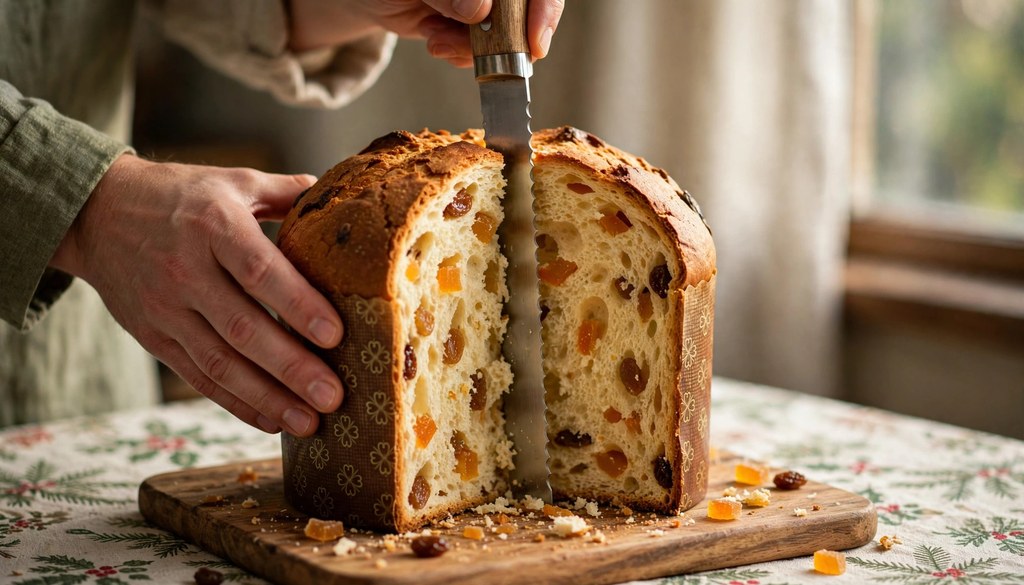
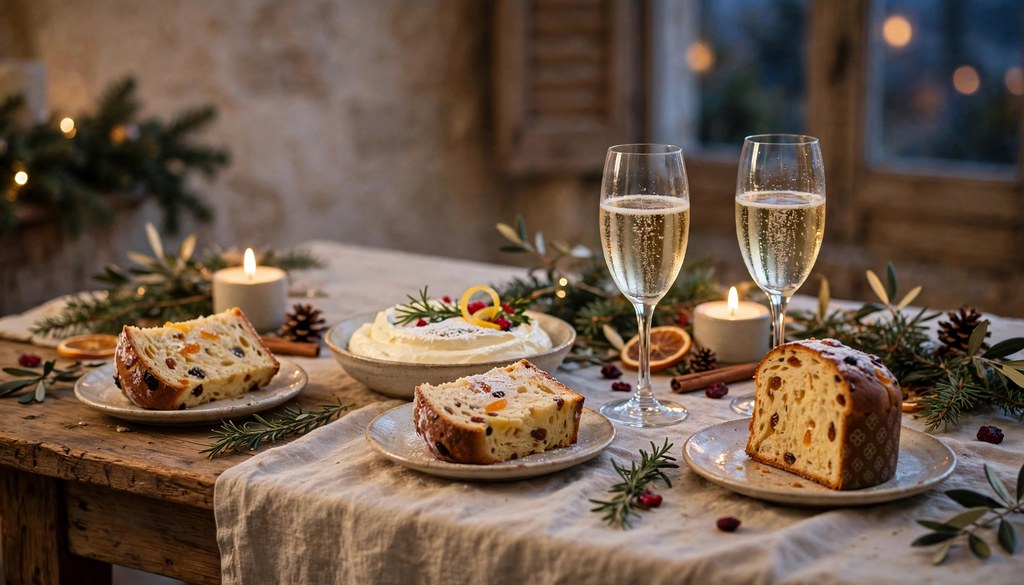
Today, Italians consume more than 33 million panettone and pandoro (Verona’s star-shaped Christmas cake) in December alone. At the table, panettone is cut vertically, from top to bottom, into wedges with a long serrated knife, and served at room temperature — sometimes with a mascarpone cream — alongside a sweet sparkling wine such as Moscato d’Asti.
Lievito Madre: A Yeast That Is Handed Down
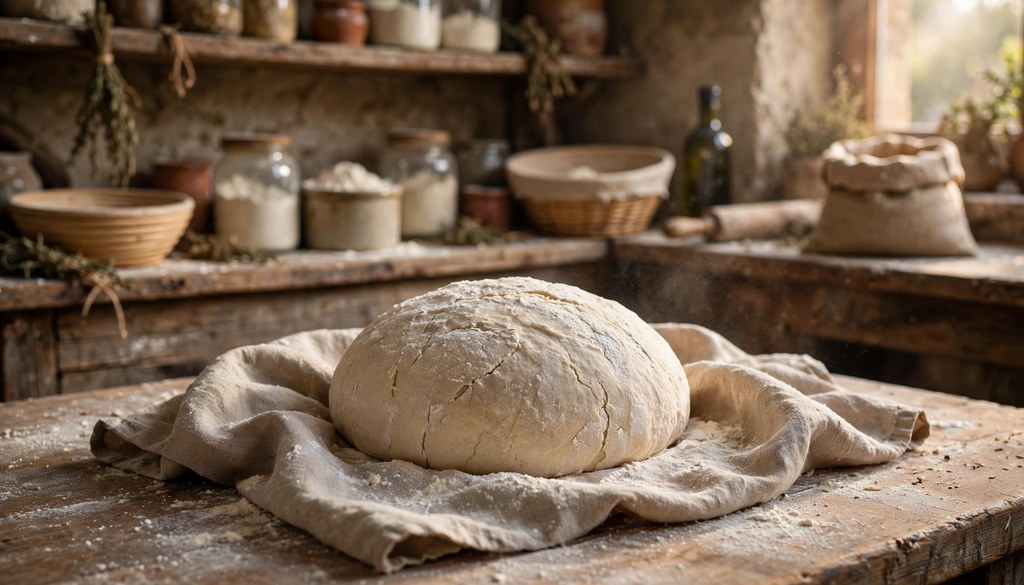
Traditional panettone is leavened by lievito madre, a firm wheat sourdough starter fed only flour and water. Bakers tend it every day, keeping it alive for years — in some bakeries, for decades — and pass it from one pair of hands to the next.
To inherit is not simply to preserve the same thing. It is to add your own time and your own hands to something that someone else has lovingly raised, and to pass it on to the next person.
Not every panettone comes from a decades-old starter; bakers also raise new ones. What matters is not the age itself, but the daily care — reading the starter’s condition and never skipping the work of feeding it.
What Makes Panettone Panettone: The 2005 Rules
In Italy, a ministerial decree of 2005 defines what may be sold as panettone. It must be naturally fermented; the butterfat must be at least 16%, egg yolk at least 4%, and raisins plus candied citrus peel at least 20% combined. No fat other than butter is allowed in the base dough.
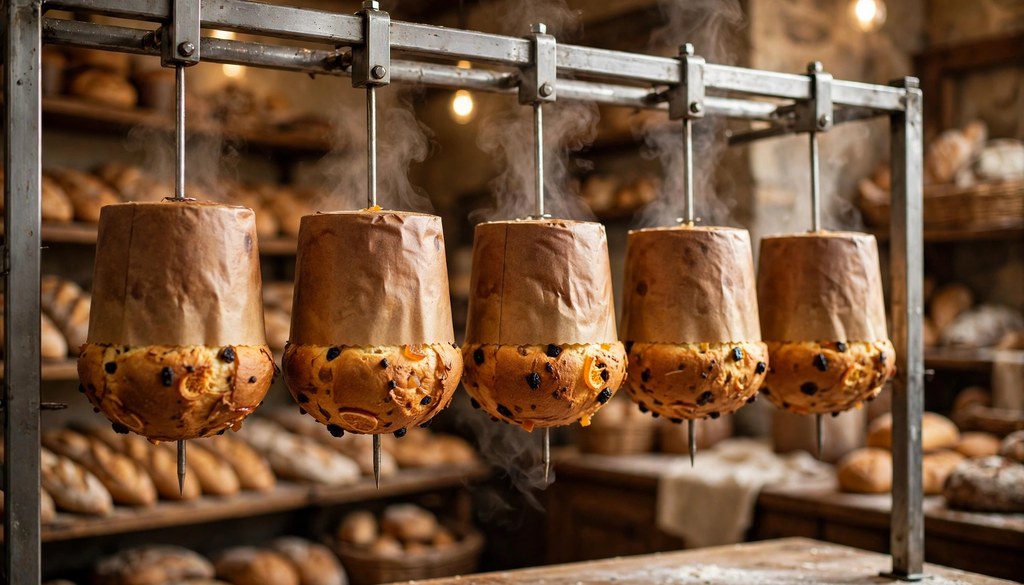
The making has its own signatures. The dough is built in two stages, and the whole process takes at least 36 hours — up to three days. Before baking, the top is cut in a cross (the scarpatura) and set with a knob of butter. After baking, the loaf is skewered through its base and hung upside down for eight to twelve hours to cool, because the crumb is so soft and rich that it would collapse under its own weight. That patience is exactly what gives panettone its lightness — and its keeping quality of a month or more even from artisan bakers.
Hanging the loaf upside down keeps the soft crumb from collapsing under its own weight. Panettone’s lightness is born from this one extra step.
A Home-Friendly Panettone-Style Recipe (Dry Yeast and a Preferment)
True panettone demands natural yeast and several days. This home version uses a dry-yeast preferment (a poolish) to approach its aroma and keeping quality. It is a panettone-style bread, not the traditional method — please enjoy it in that spirit.
Ingredients (one 15 cm tall paper mould)
[Preferment] 60 g strong bread flour, 60 g lukewarm water, 1 g instant dry yeast, 5 g sugar
[First dough] all the preferment, 90 g strong bread flour, 30 g sugar, 2 egg yolks, 30 g milk, 30 g unsalted butter, softened
[Second dough] all the first dough, 100 g strong bread flour, 40 g sugar, 10 g honey, 3 egg yolks, 3 g salt, 60 g unsalted butter, softened, a little vanilla, zest of 1 orange, 80 g raisins (soaked and drained), 50 g candied orange peel
Method
1. Mix the preferment and ferment at room temperature for 8–12 hours, until bubbly and risen two to three times.
2. Make the first dough: add the flour, sugar, yolks and milk to the preferment and knead; work in the softened butter last. Ferment 2–3 hours until risen two to three times.
3. Make the second dough: add the flour, sugar, honey, yolks, salt, vanilla and orange zest to the first dough and knead; work in the butter a little at a time. When the dough is smooth, mix in the drained raisins and orange peel evenly.
4. Round the dough, place it in the paper mould, and proof 3–4 hours until it nears the rim.
5. Cut a cross in the top and place 10 g butter (extra) in the centre. Bake at 170°C / 340°F for 35–40 minutes (internal temperature 92–94°C / 198–201°F).
6. Immediately push two skewers through the base and hang the loaf upside down for at least 4 hours, ideally overnight. Slice only when completely cool.
Panettone Today
Panettone’s popularity has grown well beyond Italy — in Japan, for example, Italian food shops and department stores fill with colourful boxes each season, popular brands sell out soon after arrival, and some local pâtissieries make their own versions with Japanese citrus such as yuzu.
A few serving ideas travel well, too: warm a slice briefly and the butter softens and the aroma opens up; leftovers make an excellent bread pudding or French toast. And panettone has a relative for another season — the colomba, a dove-shaped Easter cake made from the same sourdough tradition, with candied orange peel only and an almond glaze. In Italy the seasons are kept strictly: each cake belongs to its own feast.
Frequently Asked Questions
What is the difference between panettone and pandoro?
Their cities and fillings differ. Panettone comes from Milan and contains raisins and candied citrus peel. Pandoro comes from Verona, is shaped like an eight-pointed star, contains no fruit, and is dusted with icing sugar. Pandoro is also richer, with a higher proportion of butter.
Why is panettone eaten at Christmas?
The custom traces back to medieval Milan, where large loaves were cut and shared at Christmas; a written record of loaves baked for Christmas survives from 1599.
What is the difference between panettone and stollen?
Both are Christmas breads, but stollen is German — dense, coated in icing sugar, and sliced little by little over the season as its flavour matures. Panettone is Italian — tall and light, and typically shared and enjoyed together once cut.
What is lievito madre?
A natural sourdough starter made from wheat flour and water. Kept alive by daily feeding, it can be handed down in a bakery for many years. Its long, slow fermentation gives panettone its aroma and long shelf life.
Why is panettone cooled upside down?
Because the crumb is exceptionally soft and rich; left upright, the loaf would collapse under its own weight. Skewering the base and hanging it preserves its light, open structure.
When is panettone eaten, and how is it cut?
In Italy it is eaten from around 8 December until Epiphany on 6 January. It is cut vertically, from top to bottom, into wedges with a long knife — never in horizontal slices.
How long does panettone keep, and how should it be stored?
Unopened, industrial panettone keeps for months and artisan versions for about 30–45 days, thanks to the sourdough fermentation and the high sugar and butter content. Once cut, press the cut faces together, return it to its bag, and store at room temperature. Avoid the refrigerator, which dries it out.
Can I make panettone with dry yeast?
Yes — a preferment, as in the recipe above, brings the aroma and texture closer. However, under the Italian decree traditional panettone must be naturally fermented, so a home version is best described honestly as panettone-style.
In Closing
What one pair of hands has raised becomes everyone’s joy at the table. Panettone holds two kinds of warmth: the warmth of raising something slowly, and the warmth of sharing its bounty.
A starter handed down, a loaf given time to rise, and one large bread cut for everyone. This Christmas, may the panettone on your table be a moment of warmth shared with someone you love.
This article is also available in Japanese: パネットーネはなぜクリスマスに食べる?ミラノ発祥の歴史と伝統、作り方
Comments