

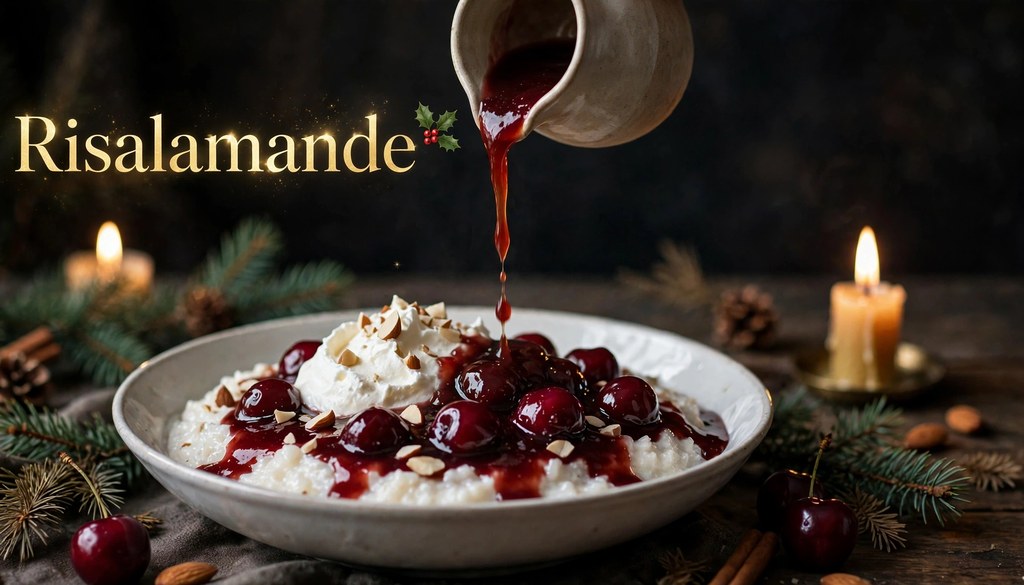
On Christmas night in Denmark, a snow-white dessert is carried to the table: risalamande — chilled rice pudding folded with whipped cream and almonds, served with warm cherry sauce. And it hides a small piece of theatre. Somewhere in the bowl sits a single whole almond, and whoever finds it receives a little gift.
This article introduces risalamande: where it came from, the story of the hidden almond, and a home recipe that starts, as tradition does, with risengrød — Danish rice porridge.
What Risalamande Is
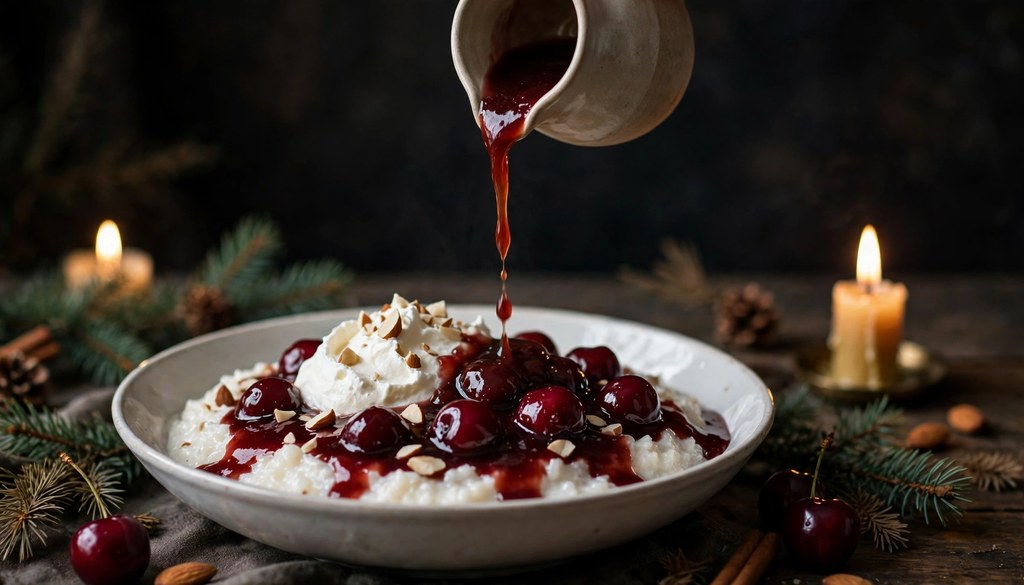
Risalamande is Denmark’s signature Christmas dessert. Rice porridge (risengrød) is cooked in milk, cooled, then mixed with sugar, vanilla and chopped almonds, and lightened with whipped cream. It is served well chilled, with warm cherry sauce poured over at the table.
The flavour is gentle: milky sweetness, vanilla, and the pleasant bite of almonds, set against the warm, sweet-tart cherry sauce — the contrast of cold pudding and warm sauce is part of the pleasure. In a Danish survey, 88% of people celebrating Christmas Eve ate risalamande, and it remains an essential part of the Danish Christmas table.
A Dessert for Christmas Eve in Denmark
In Denmark, the heart of Christmas is Christmas Eve, 24 December. Families gather for a feast of roast pork or roast duck, and risalamande arrives as the dessert.
The day before has its own place in the story. 23 December is called lillejuleaften — “little Christmas Eve” — and many families cook a big pot of warm risengrød that day, eaten simply with cinnamon sugar and a knob of butter. The leftovers are set aside and chilled, and on the 24th they are transformed into risalamande. The Christmas dessert is quietly connected to the previous day’s table.

Warm risengrød is also said to be the favourite food of the nisse, the household spirit of Scandinavian folklore. A bowl of porridge is traditionally put out for the nisse at Christmas — so the Danish Christmas table holds stories for people and for spirits alike.
Where the Name Comes From
“Risalamande” sounds French, and it is — up to a point. The name was formed in Danish from the French phrase riz à l’amande, “rice with almonds”. According to the Danish dictionary, no dessert by this name exists in French: the name is French in style, but the dish itself grew up in Denmark.
In the Denmark of the late 19th and early 20th centuries, French cooking stood for refinement. Giving a humble rice porridge a French-sounding name, and dressing it with cream and almonds, turned it into something special. The name may preserve that wish to make Christmas Eve a little more elegant.
From Risengrød: A Short History
Risengrød itself is much older. When rice and milk were precious, rice cooked in milk was a luxury — records from the 16th century show it served at noble tables. As rice gradually became more available, risengrød settled in as the simple, traditional Christmas porridge.
Recipes for risalamande appear in cookbooks in the 1870s: Madam Mangor’s Danish cookbook included a riz à l’amande, though hers used gelatine and wine and was not yet a Christmas dish. A recipe followed in Frøken Jensen’s famous cookbook of 1901, and around 1900 risalamande became known as a Christmas dish in well-to-do homes.
Its nationwide spread, however, came later. During the Second World War and the rationing years that followed, housewives stretched scarce rice by folding in whipped cream — the elegant form was also a thrifty one. In post-war Denmark, risalamande became the national Christmas dessert. It is not a tradition of many centuries, but one grown within living memory, over roughly the last hundred years.
One Almond, and a Gift for Luck
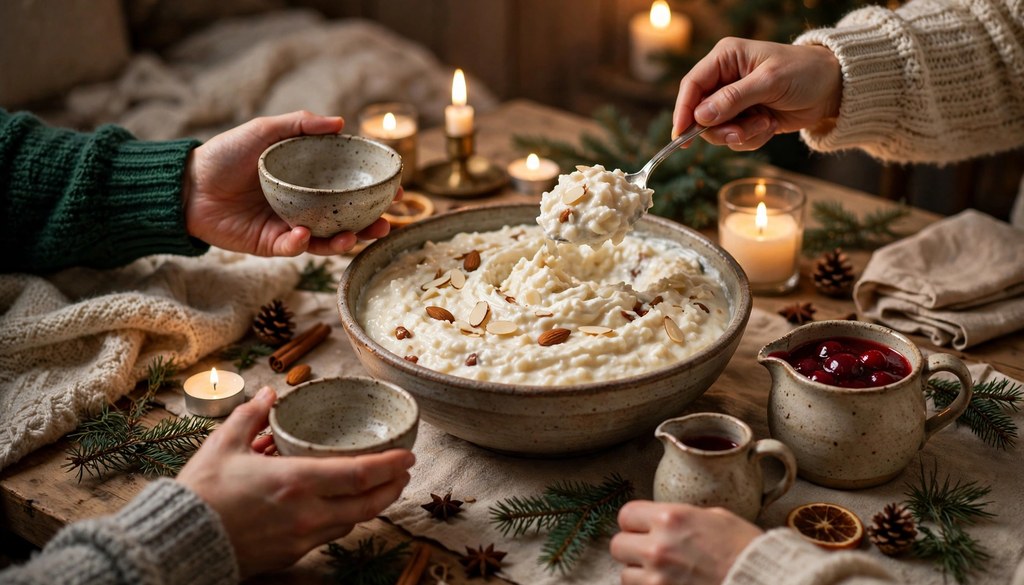
The hidden almond is the heart of risalamande. One whole blanched almond is hidden in the serving bowl. Everyone helps themselves and eats on, until the almond turns up in someone’s portion.

The finder receives a small gift called the mandelgave — the “almond gift”. A marzipan pig is the best-known form, though the gift varies from family to family. And there is a second rule: the finder must keep the discovery secret until the bowl is empty. Everyone else keeps eating, each hoping the almond might still be in their own dish. That shared suspense may be the tradition’s greatest pleasure.
The game is older than the dessert. It is explained as descending from the French Epiphany custom of hiding a bean in a cake, the finder becoming the celebration’s central figure; in Denmark, around 1800, the bean is said to have given way to an almond. The earliest gifts were not objects but privileges — a kiss, or a wish. When the marzipan pig became the standard prize, nobody actually knows.
The richness of luck is not measured only by what we receive. There is an irreplaceable joy, too, in sharing a small moment of chance together — never knowing to whom it will come.
Cold Pudding, Warm Cherry Sauce
The other star of risalamande is the cherry sauce — kirsebærsauce in Danish — made from tart sour cherries. December is not cherry season in Denmark, so jarred or frozen cherries are the norm.
The sauce was already there in the earliest recipes of the 1870s, served cold at the time; today most families serve it warm — in the survey, 75% chose warm sauce. Cold white pudding, warm red sauce: the contrast brings colour and fragrance to the winter table. Historical sources also record orange sauce and prune sauce as alternatives.
Christmas in Danish Homes Today
Today risalamande is enjoyed in many forms. Ready-made risengrød, jarred cherry sauce and even ready-to-eat risalamande line the shop shelves, while many families still make it from scratch. The almond game continues in countless homes, filling the end of the Christmas Eve meal with laughter.
Cousins of the dish live across the Nordic region: Sweden’s ris à la Malta, served with oranges or jam, and Norway’s riskrem, with a red berry sauce. Rice, cream and celebration — the combination has taken root throughout the northern winter.
The Recipe: Risalamande from Risengrød
Following tradition, the porridge is made the day before and the dessert assembled on the day. Quantities are adjusted to ingredients available outside Denmark.

Ingredients (serves 6)
For the risengrød:
- 180g short-grain rice (Japanese short-grain rice works well)
- 1 litre whole milk
- 1 vanilla pod
- A pinch of salt
For the risalamande:
- All of the chilled risengrød
- 100g blanched almonds
- 3 tablespoons sugar (about 40g)
- 500ml double (heavy) cream
- 1 whole almond (for the game, optional)
For the cherry sauce:
- 500g cherries (jarred or frozen sour cherries), with their juice
- 2–3 tablespoons sugar
- 1 tablespoon cornstarch
Method
The day before — make the risengrød:
- Split the vanilla pod and scrape out the seeds.
- Put the rice, milk, vanilla seeds and pod, and salt in a heavy pot over low heat.
- Cook gently for about 45 minutes, stirring now and then so it does not catch, until the rice is tender and the porridge is thick and creamy.
- Remove the vanilla pod, let the porridge cool, then chill it thoroughly in the fridge.
On the day — assemble the risalamande:
- Blanch the almonds briefly in hot water, slip off the skins and chop them coarsely, keeping one whole almond aside for the game.
- Stir the sugar and chopped almonds into the chilled risengrød.
- Whip the cream to soft peaks and fold it into the rice in two additions, keeping it light.
- If you are playing the game, hide the one whole almond. Transfer to a serving bowl and chill for at least 1 hour.
The cherry sauce:
- Put the cherries and their juice in a pan with the sugar and warm through.
- Stir in the cornstarch dissolved in a little water and simmer gently until slightly thickened. Serve warm over the cold risalamande.
A note on the almond game: the tradition is delightful, but a whole almond can be a choking hazard, especially for small children and anyone with difficulty swallowing. There is no need to play it exactly as tradition dictates — a card with an almond drawn on it, hidden under one plate, decides the “winner” just as happily and keeps the fun intact.
Make the risengrød the day before and chill it completely. If the porridge is still warm when the cream goes in, the cream melts and the dessert turns soupy. Let it cool first, then refrigerate until fully cold.
Storage
Finished risalamande keeps in the fridge for 1–2 days. The risengrød on its own keeps for 2–3 days chilled, which is why the traditional rhythm — porridge the day before, dessert on the day — is also the practical one.
Frequently Asked Questions
What is risalamande?
It is Denmark’s Christmas dessert: chilled rice porridge (risengrød) mixed with sugar, vanilla, chopped almonds and whipped cream, served with warm cherry sauce.
Why is it eaten on Christmas Eve?
Because in Denmark the main celebration is Christmas Eve, 24 December, and risalamande became its traditional dessert. The flow of the days supports it: warm risengrød on 23 December, its leftovers transformed into risalamande on the 24th.
Why is one almond hidden in it?
It is a Christmas game: the person who finds the almond receives a small gift. The custom is explained as descending from the French Epiphany tradition of hiding a bean in a cake; in Denmark the bean is said to have been replaced by an almond around 1800.
What does the finder receive?
A small present called the mandelgave, the “almond gift”. A marzipan pig is the best known, but the gift varies by family. By tradition, the finder keeps the discovery secret until the bowl is empty.
What is the difference between risalamande and risengrød?
Risengrød is the warm rice porridge itself, cooked in milk. Risalamande is what it becomes when cooled and finished with sugar, almonds and whipped cream, served cold as a dessert.
Why does risalamande have a French-sounding name?
The name was formed in Danish from the French riz à l’amande, “rice with almonds”. No French dessert carries this name — the name is French in style, but the dish is Danish.
Can I make it with Japanese rice?
Yes. Denmark uses a short-grain pudding rice, and Japanese short-grain rice gives a close result. Cook it gently over low heat and stir now and then, as it catches easily.
Can I make it ahead? How should I store it?
The risengrød is traditionally made the day before and keeps 2–3 days in the fridge. Once the cream is folded in, eat the finished risalamande within 1–2 days, kept chilled.
More Christmas Flavours of the World
Risalamande is only one of the season’s stories. If you would like to travel further, our roundup gathers six Christmas dishes — stollen, panettone, bûche de Noël and more — each with a heart of its own.
Christmas Flavours of the World: From Stollen to Eggnog — Six Stories of the Season’s Table
Curious About Japan’s Christmas Cake?
In striking contrast to Denmark, Japan made the strawberry shortcake the star of its Christmas table. This article traces how that happened.
Why Do Japanese People Eat Strawberry Shortcake at Christmas? History, Traditions and Recipe
Closing
A single almond can turn an ordinary table into a small adventure. May finder and fellow-laughers alike keep an unforgettable Christmas moment from that one small grain of luck.
Japanese version: 「リサラマンデとは?デンマークのクリスマスに隠されたアーモンドの伝統と歴史、作り方」

Comments