
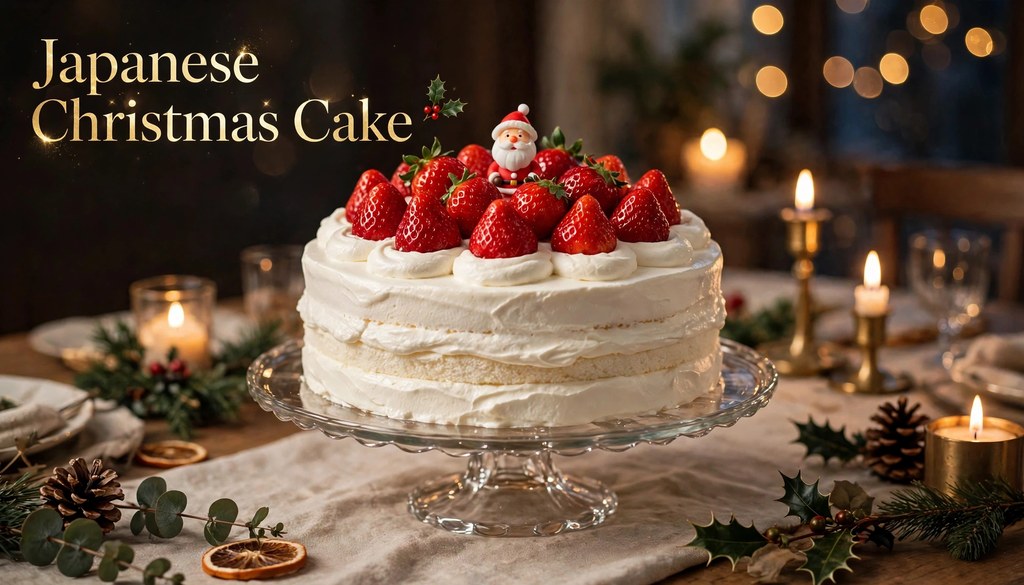
Ask someone in Japan to picture a Christmas cake, and they will almost certainly describe the same thing: a round sponge cake covered in white whipped cream and topped with bright red strawberries. Light, soft and made to be shared, it appears everywhere in December — in pâtisserie windows, department store food halls and convenience stores — usually reserved in advance and picked up on Christmas Eve.
Yet this cake looks nothing like the Christmas cakes of Europe or America. Britain has its dark fruitcake and flaming Christmas pudding, France its log-shaped bûche de Noël, Germany its stollen. A strawberry shortcake as the centrepiece of Christmas is, in fact, a distinctly Japanese tradition.
So why strawberry shortcake? The answer lies in a Yokohama cake shop founded in 1910, in the changing kitchens of post-war Japan, and in a century of quietly reshaping a borrowed celebration into something of their own.
In this article we trace the history of Japan’s Christmas cake, explain how the strawberry shortcake became the classic, and finish with a recipe for a 15cm (6-inch) homemade version.
What Is a Japanese Christmas Cake?
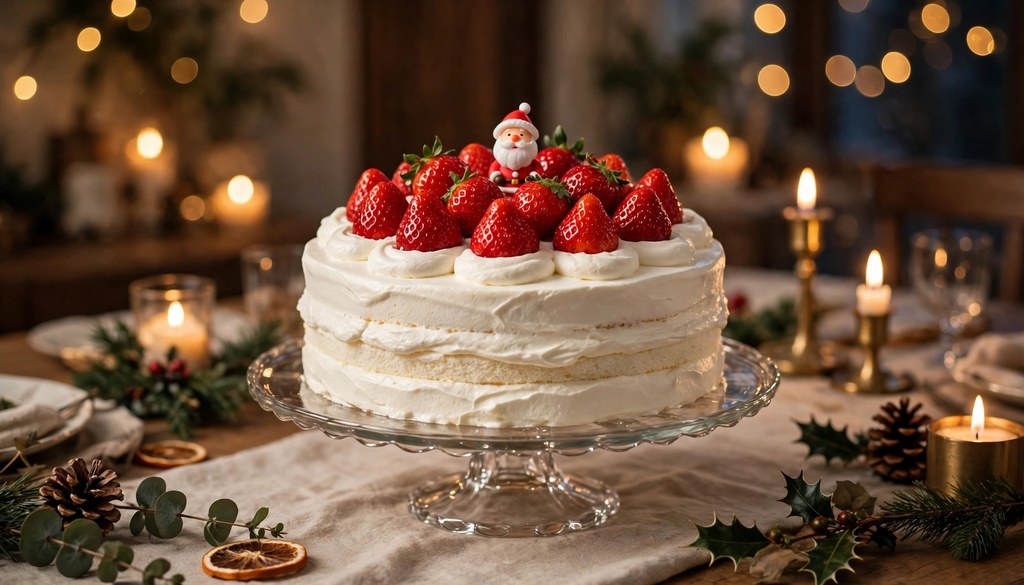
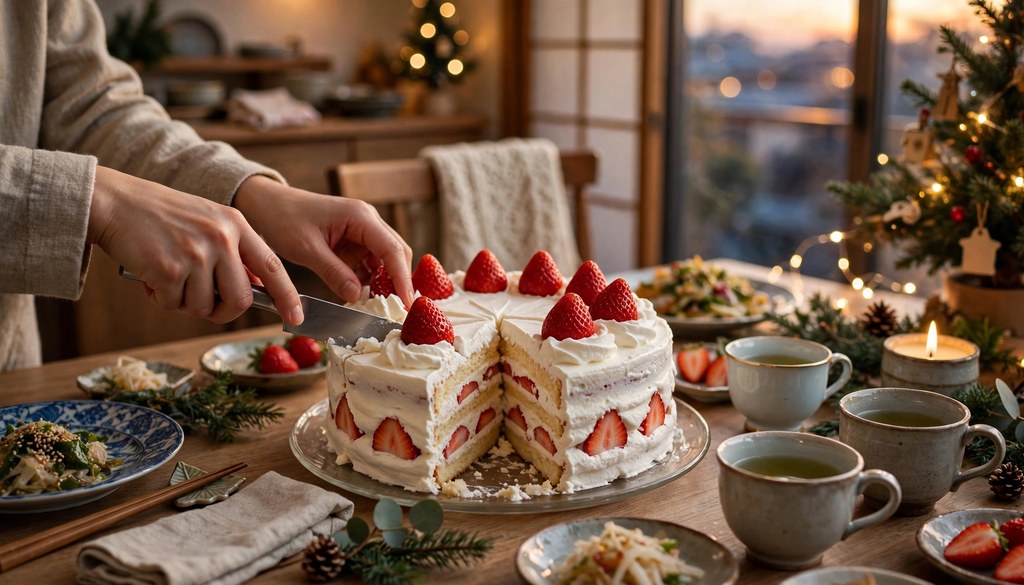
Japan’s classic Christmas cake is a strawberry shortcake: layers of soft sponge filled with whipped cream and strawberries, covered in white cream and decorated with more strawberries and, often, a small Santa figure. It is sold whole, not by the slice, because cutting and sharing it at the table is part of the celebration.
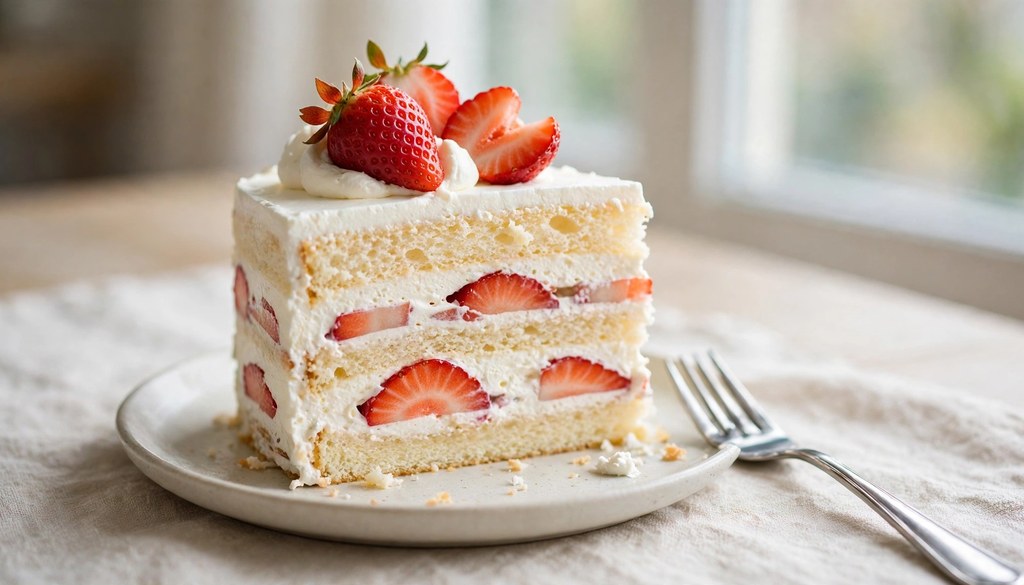
One point of confusion for overseas readers: the word “shortcake” means something different in Japan. In America and Britain, a shortcake is usually built on a firm, biscuit-like base. The Japanese shortcake is built on a light, egg-foamed sponge. Same name, different cake — the Japanese version is a creation of Japan itself, often described as Japan’s distinctive strawberry-and-whipped-cream celebration cake.
Most families eat it around Christmas Eve, 24 December, during the last days of the year. Its popularity is not nostalgia alone: in a large 2025 survey (37,355 responses), shortcake was still the runaway first choice for Christmas cake, chosen by 54% of respondents, far ahead of bûche de Noël in second place at 17%.
1910: Fujiya and the First Chapter
The story usually begins with Fujiya, a Western-style confectioner in Yokohama. According to the company’s own history, its founder, Rin’emon Fujii, opened his shop in the Motomachi district in November 1910 and sold a Christmas cake that December.
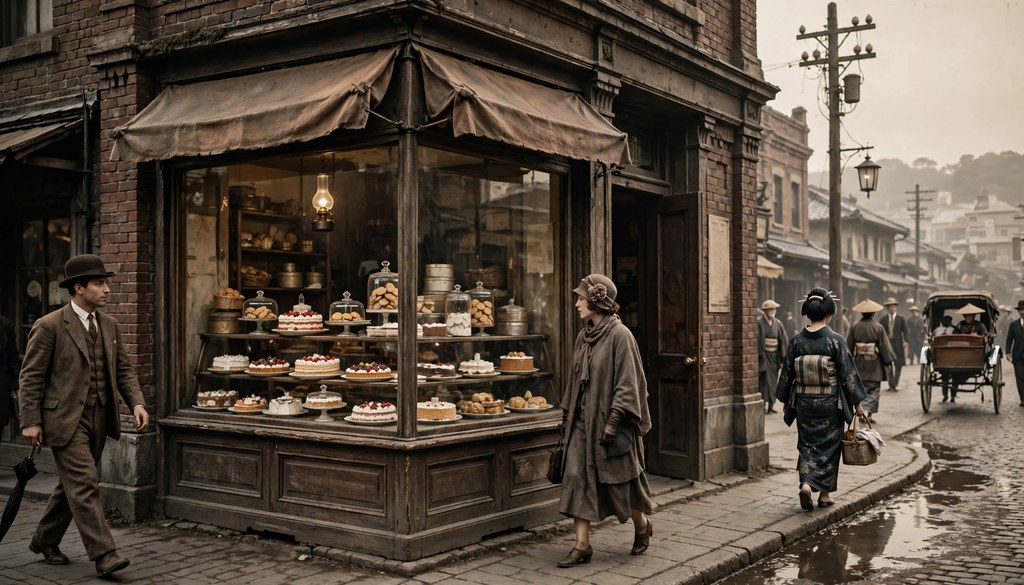
That first cake, however, looked nothing like today’s. As Fujiya’s records and later accounts describe it, it was a fruitcake of liqueur-soaked dried fruit under a white sugar icing, decorated with silver balls — much closer to a British Christmas cake than to a strawberry shortcake. There were no strawberries, and no fresh cream.
It is also worth being precise: Fujiya cannot be proven to have sold Japan’s very first Christmas cake. Research collected by the National Diet Library’s reference database notes an advertisement from 1878 and an account from 1904, and treats the origin as unsettled. Fujiya’s 1910 cake is best described as one of the clearest dated company records — the point where the story becomes traceable.
1922: The Japanese Shortcake Is Born
The step that leads to the modern cake came in 1922, when, according to Fujiya’s history, Rin’emon Fujii released his shortcake, priced at 8 sen apiece.
Fujii had travelled to the United States in 1912 and encountered the American shortcake there. But its heavy biscuit base did not suit Japanese tastes, so he replaced it with a soft sponge, lightened by whipped eggs, and paired it with cream and fruit. That single substitution — remaking a foreign cake in a shape local people would love — is the true starting point of the Japanese shortcake.
Two cautions belong here. First, Fujiya is not the only claimant: the Tokyo confectioner Colomban also credits its founder, Kuniteru Kadokura, with creating the shortcake, and the National Diet Library database presents both accounts side by side without deciding between them. Second, we do not actually know whether strawberries crowned those early shortcakes. The red-and-white cake of today had not yet taken its final form.
After the War: How the Cake Became the Classic
The strawberry shortcake needed the post-war decades to become the Christmas classic.
In 1952, Fujiya held its first Christmas sale, with shortcakes in the shop window; from there, the cake began its spread into ordinary homes. Television commercials for shortcake followed from 1958.
Surprisingly, the star of those years was not fresh cream. Until the mid-1960s, buttercream cakes sold better — fresh cream spoils quickly and was hard to handle before refrigeration was widespread. Fujiya’s 1967 Christmas cake was still finished in buttercream. The turning point was refrigeration itself: chilled shop display cases and a refrigerator in every home made fresh-cream cakes practical, and by the mid-1970s fresh cream had overtaken buttercream. The strawberry shortcake’s place in Christmas culture was secure.
The last piece was the strawberry. Strawberries are naturally a spring fruit; their presence in December is thanks to greenhouse forcing cultivation, which shifts the harvest into the winter months. Winter strawberries were a luxury for a long time, but as growing techniques and distribution improved, they became reliably available exactly when Christmas needed them. Sponge, fresh cream, winter strawberries — with all three in place, Japan’s Christmas cake was complete.
Why the Red and White Cake Is Loved
White cream and red strawberries happen to echo red and white, the colours of celebration in Japan. The cake looks like snow topped with something bright and joyful, and it lights up a winter table.
Honesty requires a footnote, though: no document from the period has been found that says the cake was designed for its colours. The symbolism is an impression later generations have layered onto it, and it is best enjoyed that way. What is certain is the taste — a light sponge, gently sweet cream and the tartness of strawberries suit the Japanese palate, and a cake that everyone from children to grandparents can share has a strength that heavier fruitcakes never had in Japan.
Receiving a culture does not only mean repeating it exactly as it came. There is a quiet joy, too, in finding the shape that fits your own life, and letting it grow, little by little. Japan’s Christmas cake may be one of the gentlest proofs of that.
Reserving and Picking Up: Christmas Eve Culture
Today, a Japanese Christmas cake is something you reserve and pick up. Famous pâtisseries and department stores open reservations around November, and popular cakes sell out by early December. Convenience stores run their own reservation campaigns — roughly ¥3,000–6,000 — while department store cakes centre on ¥5,000–8,000. Frozen cakes by mail order have also spread, bringing celebrated shops to homes far away.
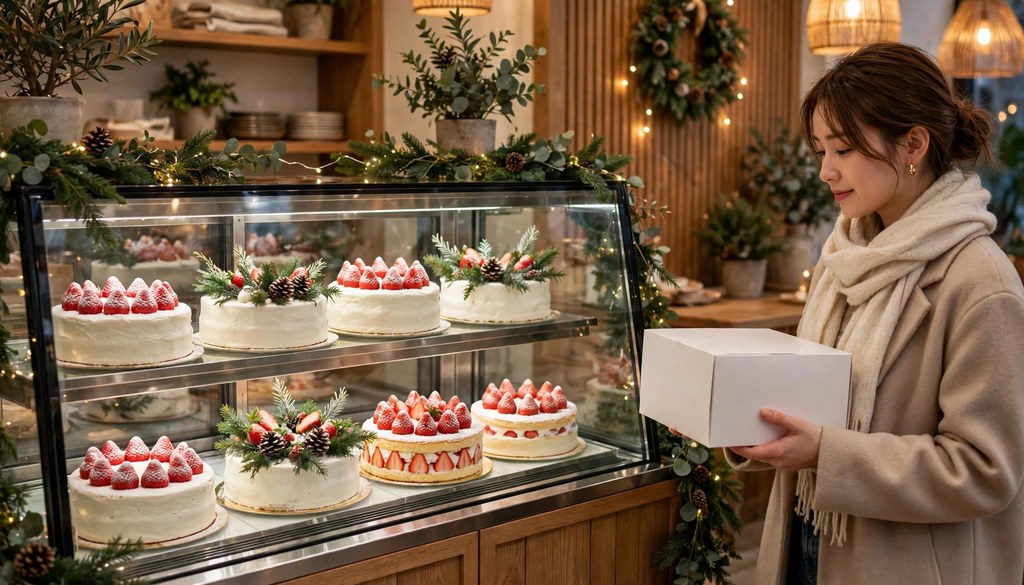
Pickup day is, above all, the 24th. The sight of people carrying cake boxes home through the December streets is one of the season’s familiar scenes. In Japan, Christmas is a day for family tables and for time with someone dear, and the moment of cutting one whole cake together sits at the centre of it.
Not every home celebrates the same way, of course. Some eat on the 25th, some enjoy a small cake alone. The shape is free — and that, too, feels true to the story of this cake.
Recipe: A Homemade Japanese Strawberry Shortcake
Here is a basic homemade version of the Japanese Christmas strawberry shortcake, made in a 15cm (6-inch) round tin: white cream, red strawberries, and the soft sponge that makes it Japanese.
Ingredients (one 15cm / 6-inch cake)
Sponge
- 3 eggs
- 90g granulated sugar
- 90g cake flour
- 20g unsalted butter
- 1 Tbsp milk
Syrup
- 50ml water
- 25g sugar
- 1 tsp kirsch (optional)
Cream and decoration
- 300ml fresh cream (heavy cream)
- 24g sugar
- About 1 pack of strawberries (around 250g; slice the ones for the layers, keep the rest whole or halved for the top)
Method
- Line the tin with baking paper and preheat the oven to 170°C (340°F). Melt the butter and milk together over hot water.
- Whisk the eggs and granulated sugar over a bain-marie. When the mixture reaches body temperature, remove it from the heat and keep whisking until it is pale, thick and falls in ribbons that hold their shape briefly.
- Sift in the cake flour and fold with a spatula, scooping from the bottom so you do not knock out the air. Add the melted butter and milk and fold until glossy.
- Pour into the tin and bake at 170°C (340°F) for 25–30 minutes, until a skewer comes out clean. Turn out onto a rack, and once the steam has escaped, wrap and cool completely.
- Make the syrup: dissolve the water and sugar in a small pan, cool, then add the kirsch.
- Slice the sponge horizontally into 3 layers (2 is fine if that is easier). Brush each cut side with syrup.
- Whip the cream with the sugar over an ice bath to soft-medium peaks.
- Spread a thin layer of cream on the bottom sponge, arrange sliced strawberries, and cover with more cream. Repeat with the next layer and top with the final sponge.
- Cover the whole cake with cream, pipe a border on top and decorate with strawberries.
- Chill for at least 30 minutes before slicing. A warmed knife gives the cleanest cut.
Keep the cream cold until the moment you whip it, and whip it over an ice bath for stability. Stop at soft-medium peaks — overwhipped cream turns grainy and separates.
Storage
Because it uses fresh cream and fresh strawberries, refrigerate the finished cake and eat it the same day or the next day. The sponge alone can be baked a day ahead and kept wrapped; assemble the cake on the day you serve it.
Frequently Asked Questions
Q1. Why do people in Japan eat cake at Christmas?
Western-style confectioners promoted Christmas cakes from the early 20th century, and as post-war life grew more comfortable, the cake became part of celebrating at home. Fujiya’s records show a Christmas cake on sale in 1910, and its first Christmas sale in 1952 helped carry the custom into ordinary households.
Q2. Why is strawberry shortcake the classic?
Because the Japanese sponge shortcake developed here, refrigeration made fresh cream practical, and greenhouse growing put strawberries in the shops in December. Its light, shareable taste also suited Japanese tables. In a 2025 survey it was still the number-one Christmas cake, at 54%.
Q3. When was Japan’s Christmas cake born?
The clearest company record is Fujiya’s Christmas cake of 1910 — but earlier advertisements and accounts exist, so the very first one cannot be pinned down. The shortcake that led to today’s cake followed in 1922, according to Fujiya’s history.
Q4. Is Japanese shortcake different from shortcake overseas?
Yes. American and British shortcakes are usually built on a biscuit-like base, while the Japanese shortcake uses a soft, egg-foamed sponge. The Japanese version began when the base was deliberately remade to suit Japanese tastes.
Q5. Do the white cream and red strawberries mean something?
They recall red and white, Japan’s colours of celebration — but no period document shows the cake was designed for that meaning. It is best treated as a happy impression that later generations added.
Q6. Do people eat it on the 24th or the 25th?
Many families eat it on Christmas Eve, the 24th, and most reservation pickups are that day — but the 25th is common too. There is no rule.
Q7. How far ahead can I make it at home?
You can bake the sponge a day ahead and keep it wrapped. Assemble with cream and strawberries on the day you serve it, and finish the cake the same day or the next.
Q8. What if I cannot get strawberries?
Tinned peaches or mandarin oranges, kiwi or blueberries all work. Pat juicy fruit dry before using it. A cake with different fruit is no longer the classic red and white — it becomes your own household’s version, which is rather in the spirit of this story.
For Readers Who Want the World’s Christmas Cakes, Too
Europe’s Christmas tables grew their own classics: Germany’s stollen, savouring the wait; Italy’s panettone, handed down and shared; France’s bûche de Noël around the firelight; gingerbread, made by hand; Britain’s Christmas pudding, stirred with wishes; and eggnog, a cup of welcome. Our roundup, Christmas Flavours of the World, tells all six stories in one place.
▶ Christmas Flavours of the World: From Stollen to Eggnog — Six Stories of the Season’s Table
Closing
A small Christmas cake, white cream crowned with red strawberries. Just as a celebration that arrived from a distant country found its own shape at Japanese tables, there is no single right way to celebrate happiness.
Europe’s Christmas cakes carry the histories of their own lands, and Japan’s Christmas cake carries a century of Japanese care. Neither is better than the other; sometimes, a culture that travels to a different land gives birth to a new kind of richness. This Christmas, when you cut into a red-and-white cake, we hope you will remember that.
Japanese version: 日本のクリスマスケーキはなぜ苺のショートケーキ?由来・歴史と定番になった理由、作り方
コメント