

Bûche de Noël, also known as a Yule log cake, is France’s traditional Christmas cake: a sponge rolled into the shape of a log and covered with chocolate buttercream bark. It looks like a log because it carries the memory of a real one — for centuries, families burned an enormous log in the fireplace at Christmas, a custom known as the Yule log. When that custom faded in the 19th century, Paris pâtissiers transferred the log’s shape to a cake.
This article traces the bûche from the fireplace to the table: the Yule log tradition, the cake’s own history, its place in the French Christmas, and a classic chocolate recipe to make at home.
What Is Bûche de Noël?
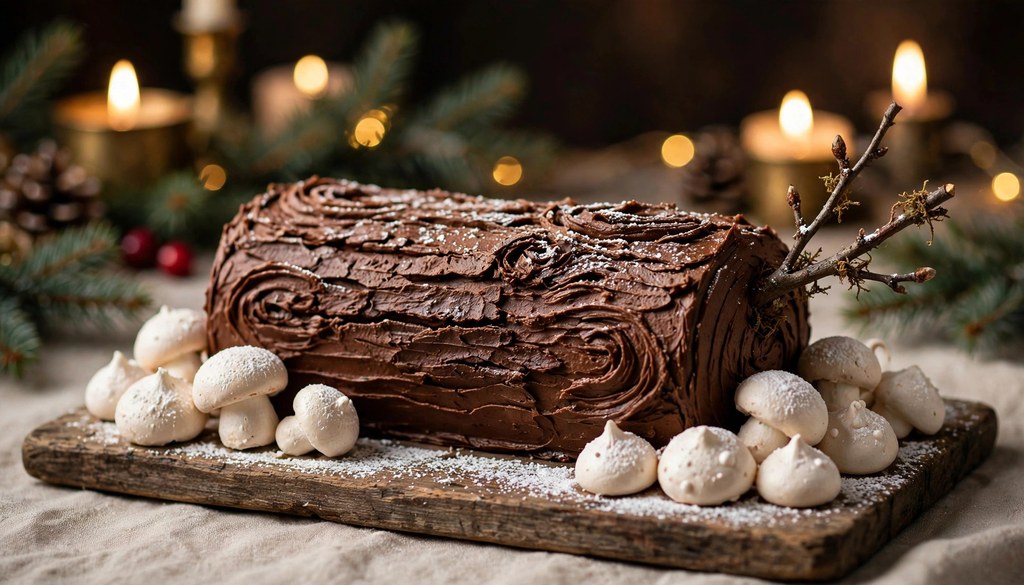
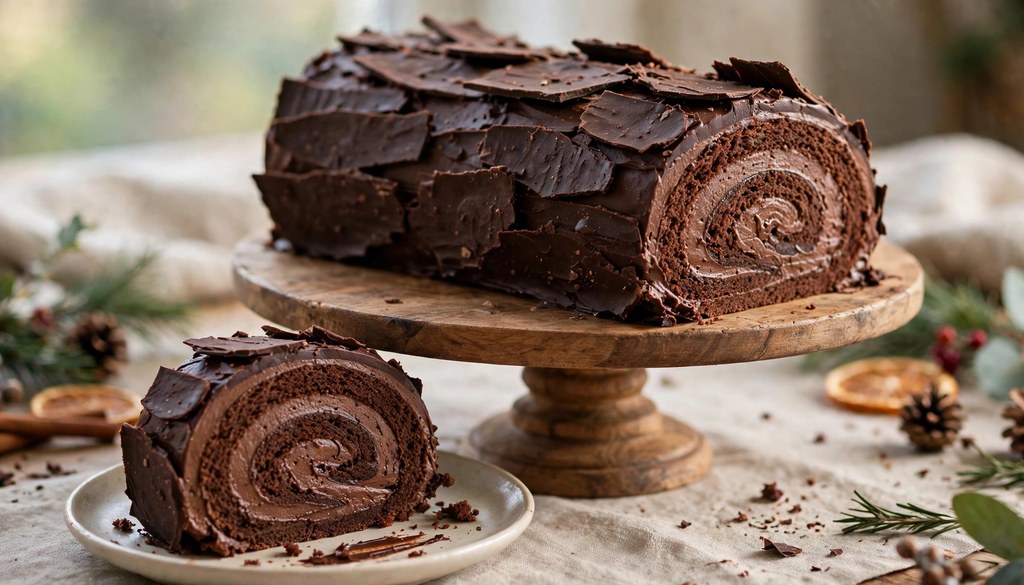
Bûche is French for “log,” and the cake is exactly that in edible form. A thin sponge (génoise) is spread with cream and rolled, then covered in chocolate-coloured buttercream scored with a fork to imitate bark. A cut-off end is set against the side as a sawn branch, and the log is finished with powdered-sugar snow and meringue mushrooms.
The classic buttercream flavours are coffee, chocolate, Grand Marnier and chestnut. Today the family also includes the bûche glacée, an ice-cream version, and the elaborate new creations that famous pâtissiers unveil every year — but the homemade chocolate log remains the heart of the tradition.
The Yule Log: Christmas Around the Fire
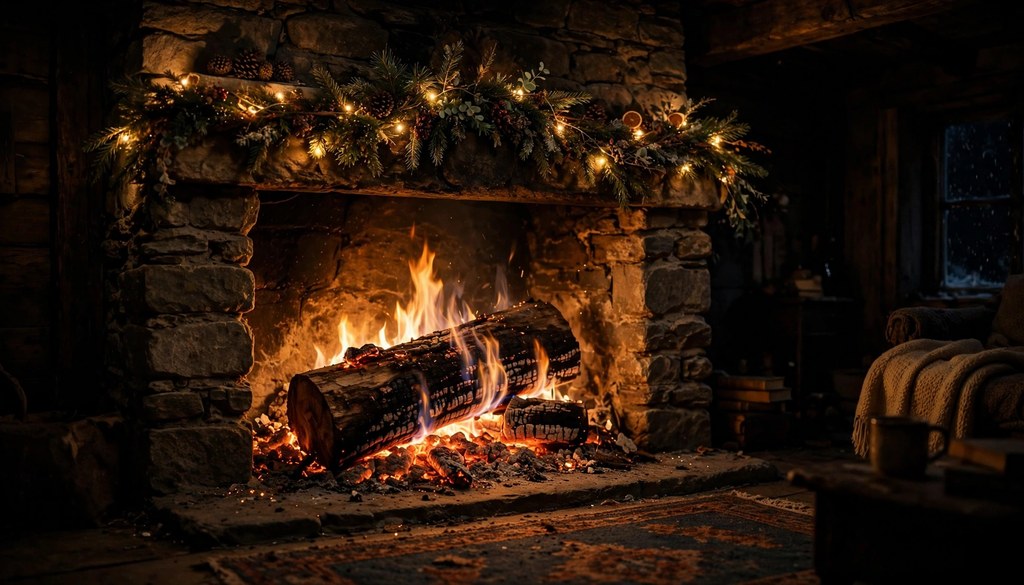
Behind the cake stands a much older custom. For centuries in France, a very large log was burned in the fireplace on Christmas Eve. It was meant to burn slowly for days — ideally until the eve of Epiphany on January 6, as long as twelve nights. One of its names, tréfeu, means “three fires”: a log that should burn for three days.
The wood itself carried wishes. In the south, fruit trees — plum, cherry, olive — were chosen in hope of a good harvest; in the north, oak and beech were preferred. In Provence, the lighting ceremony called cacho-fiò had the oldest member of the household and the youngest child carry the fruitwood log together and pour sweet wine over it as it was laid on the fire. The two ends of a family’s generations, gathered around one flame — that picture is the heart of the custom.
Even the remains were treasured. The ashes and charred pieces were believed to protect the house from lightning and illness; ashes were kept, or scattered on the fields for fertility, and in some homes the previous year’s charred remnant lit the next year’s log, so the fire itself linked one Christmas to the next.
The custom is often traced to ancient midwinter fire festivals, but firm records begin in the Middle Ages — a document from 1184 mentions a log for the Christmas Eve fire — and scholars still debate the older origins. What is certain is simpler: for a very long time, the log’s fire was something a family gathered around, and wished over.
The richness of a light is not measured by its brightness alone. There is an irreplaceable warmth in gathering around the same fire, and simply spending unremarkable time together.
From Log to Cake: The Bûche’s Own History
As homes with great open fireplaces slowly disappeared, the burning of the log faded from the 18th century onward. It was the pâtissiers of 19th-century Paris who preserved its shape — in cake.
The firmest early landmark is 1890, when the pâtissier Pierre Lacam published a bûche de Noël recipe in his book on the history of pastry. His version differed from today’s: instead of a rolled sponge, discs of génoise were stacked into a log shape, filled with coffee or chocolate buttercream over a vanilla sponge — a pale “wood” inside a dark “bark” — and decorated with chopped pistachio “moss” and meringue mushrooms.
Who made the very first one is unknown. Stories credit an apprentice in Paris in 1834, a chocolatier in Lyon, a pâtissier in 1879 — the accounts contradict each other, and no inventor can be established.
The bûche in its modern, rolled form spread across France only after the Second World War, around 1945–50; France’s Ministry of Agriculture likewise dates the rolled shape to the mid-20th century. The history of the log and the history of the cake are two stories, separated by centuries.
Bûche de Noël at the French Christmas Table
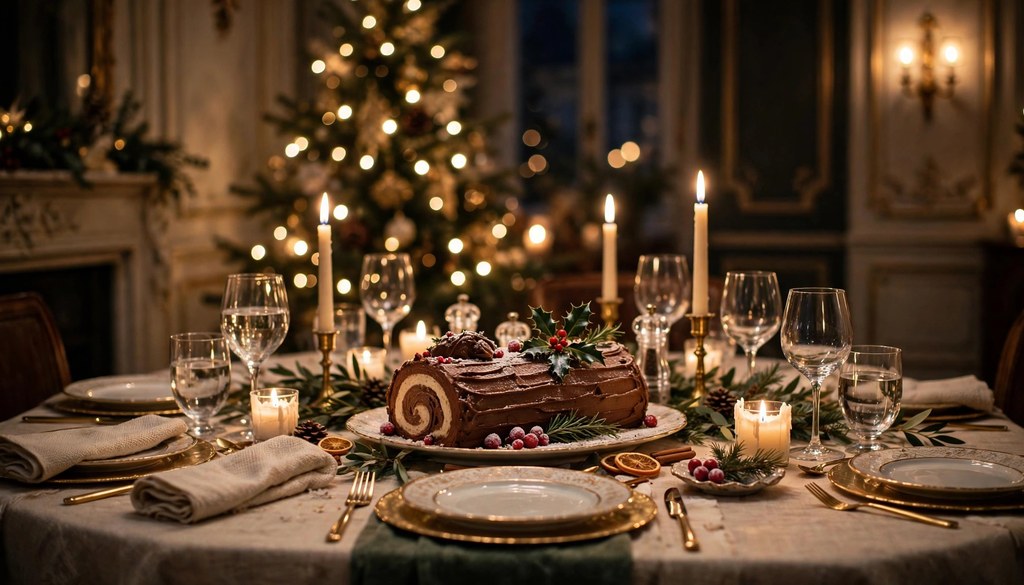
Christmas in France is celebrated with the réveillon, the long Christmas Eve dinner. Family and close friends linger over course after course, and the meal closes with the bûche de Noël, sliced and shared at the table. The custom travelled with the French language to Belgium, Switzerland, Quebec and beyond.
In modern France, the frozen bûche glacée is a major presence: the frozen-food retailer Picard reports selling two million bûches a year on its own. Most bûche sales are said to be concentrated in the last three weeks of December. At the same time, Paris’s great pâtisseries present new bûches each year like seasonal collections. A homemade tradition and high pastry live side by side in the same food culture.
Mushrooms, Snow and Bark: A Winter Forest in Miniature
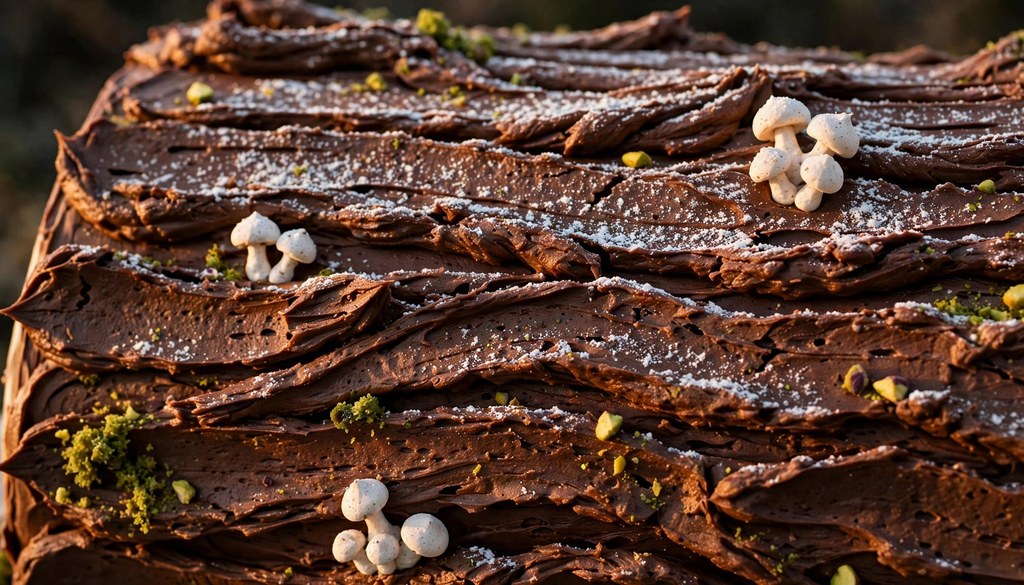
Every decoration on a bûche is a piece of winter scenery. The buttercream, raked with a fork or piped through a ridged nozzle, is tree bark. The offcut, set at an angle, is a sawn branch. A dusting of powdered sugar is snow; little meringue mushrooms rise from the forest floor; chopped pistachio becomes moss. In earlier days, sugar figurines — Santas, tiny axes and saws — joined the scene. A whole cake holds the forest where the fireplace log once lay.
A Classic Bûche de Noël Recipe: Chocolate Buttercream
This home recipe follows the traditional French structure: a chocolate sponge rolled with chocolate buttercream. The key step is rolling the sponge while it is still warm, so it learns the shape without cracking.
Roll the sponge while it is still warm from the oven so it learns the shape. A cooled sponge cracks when rolled.
Ingredients (serves 8; one 30×40 cm / 12×16 in sheet pan)
Sponge: 4 eggs, 120 g sugar, 100 g cake flour (or all-purpose), 20 g cocoa powder, a pinch of salt
Buttercream: 200 g dark chocolate, 200 g unsalted butter (at room temperature), 100 g powdered sugar
To finish: powdered sugar, for the snow
Method
1. Make the sponge. Whisk the eggs and sugar over warm water until thick and pale, to the ribbon stage. Fold in the sifted flour, cocoa and salt, spread on the lined pan, and bake at 180°C (350°F) for 10–12 minutes. Do not overbake — a dry sponge cracks when rolled.
2. As soon as it comes out of the oven, turn the sponge onto a damp cloth (or a fresh sheet of parchment), peel off the paper, and roll it up with the cloth while still warm. Leave to cool in the roll so it holds the shape.
3. Make the buttercream. Beat the softened butter with the powdered sugar until pale, then mix in the melted, slightly cooled chocolate.
4. Unroll the cooled sponge, spread about two-thirds of the buttercream, and roll it up again. Cut one end at an angle and place it against the side as a branch.
5. Cover the whole log with the remaining buttercream and draw bark lines with a fork. Dust lightly with powdered sugar for snow.
6. Chill for at least 2–4 hours, ideally overnight. Take it out of the fridge 15–30 minutes before serving so the cream softens.
Bûche de Noël in Japan
The bûche has also taken root far from France. In Japan, a 2025 survey by Mapion (37,355 responses) asking which Christmas cake people would most like to eat placed bûche de Noël second, behind only the strawberry shortcake that reigns over Japanese Christmas. The retailer Fujiya’s 2025 best-seller list likewise ranked its bûche among the top whole cakes, with a mini version near the top of the small-cake chart. In Japan the strawberry shortcake is the star of Christmas — and the French log has quietly become its most established companion.
Frequently Asked Questions
What is bûche de Noël?
France’s traditional Christmas cake. Its name means “Christmas log” in French, and it is made from sponge and cream shaped and decorated as a log. It is served as dessert at the Christmas Eve dinner or the Christmas Day meal.
Why is it shaped like a log?
Because of the old custom of burning a large log in the fireplace at Christmas. After the custom faded, 19th-century Paris pâtissiers transferred the log’s shape to a cake.
What is a Yule log?
The large log burned in the fireplace at Christmas, and the custom around it. The log burned for days, and its ashes and charred remains were believed to protect the house. “Yule” is the name of a northern European midwinter festival, from which the custom is often said to descend.
When did people start eating it?
Cakes in log form are recorded in 19th-century Paris, and a recipe was published in a book in 1890. The rolled form familiar today, however, spread across France only after the Second World War. Its inventor is unknown — several competing stories exist.
How is it different from a Swiss roll?
Structurally, a bûche de Noël is a kind of Swiss roll (roulade). The difference is the finish and the meaning: it is a cake made only for Christmas, dressed with bark lines, a sawn branch, powdered-sugar snow and meringue mushrooms to carry the story of the fireplace log. An ordinary Swiss roll has no such symbolism.
Can I make it at home?
Yes. The basics are a thin sponge and buttercream, as in the recipe above. The trick to rolling without cracks is to roll the sponge once while it is still warm from the oven, so it sets in the shape.
How far ahead can I make it, and how should I store it?
A homemade buttercream bûche keeps for 2–3 days in the fridge. Making it the day before is ideal — the flavours settle and it slices cleanly. It also freezes well for about a month if wrapped tightly before decorating; thaw slowly in the fridge and add the decorations afterwards.
Why the mushrooms and snow decorations?
They recreate a winter forest: powdered sugar is snow, meringue mushrooms are the forest floor, and the chocolate lines are bark — the landscape where the fireplace log once lay, rebuilt on a cake.
How does it differ from stollen and panettone?
Stollen (Germany) and panettone (Italy) are yeasted, bread-like cakes that keep for weeks or months and are eaten slice by slice. Bûche de Noël is an unfermented sponge-and-cream cake that lives for only a few days in the fridge. In return, it carries the story of the burning log in its very shape.
Closing
Germany’s stollen carries the time of waiting for Christmas to the table; Italy’s panettone carries the warmth of something inherited and shared. France’s bûche de Noël carries something else: the time of being together, gathered around one light.
The shape of the log that once lit the fireplace now graces the Christmas table as a cake. The shape has changed, but the wish to share warmth with someone remains beside it still.
May the table where you slice a bûche de Noël this winter be a place of shared light.
This article is also available in Japanese: ブッシュ・ド・ノエルはなぜ薪の形?由来と歴史、フランスのクリスマス伝統と作り方
コメント