

As November draws to a close, a long, white loaf begins to appear in bakery windows: stollen, dusted thickly with powdered sugar. In Japan as in Germany, it has become known as a Christmas treat to slice thinly and enjoy little by little in the days before Christmas.
But why is stollen eaten at Christmas at all?
The short answer: stollen began as a bread for Advent, the season of waiting for the birth of Christ. It started as a plain fasting loaf, grew rich with butter and fruit, and over more than 500 years became a cake that carries the very feeling of waiting for Christmas.
Its story includes a letter sent to the Pope and a giant stollen weighing 1.8 tonnes, baked for a king. Let us follow it step by step.
What Is Stollen?
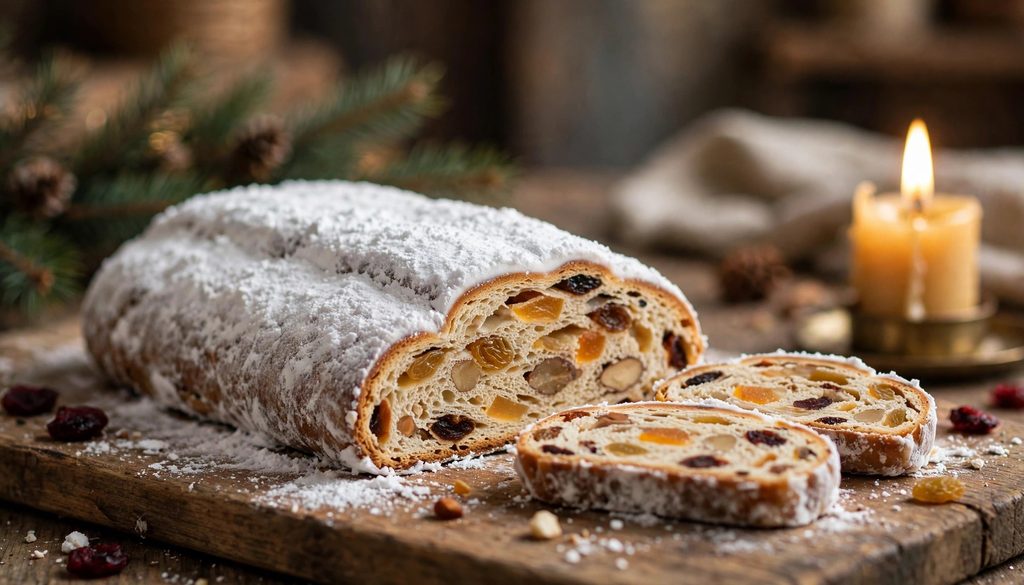
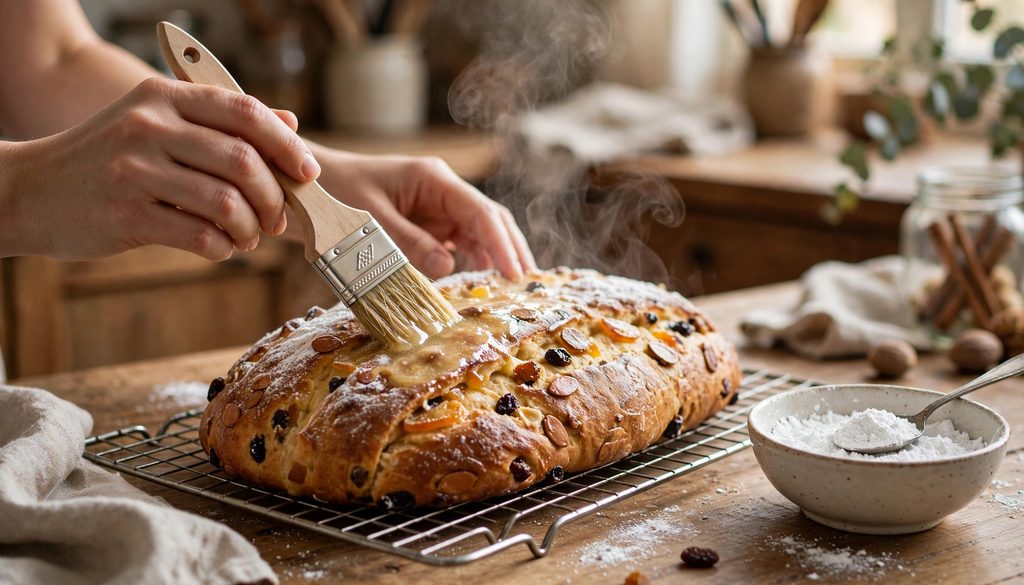
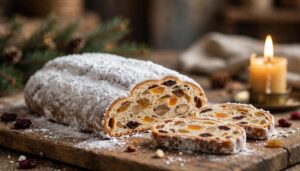
Stollen is a traditional German Christmas bread, made from a yeasted, butter-rich dough filled with rum-soaked raisins and other dried fruit, candied orange peel, almonds, and warm spices such as cinnamon and cardamom. Straight from the oven it is brushed with melted butter and coated thickly with powdered sugar, which gives it its distinctive white appearance.
Its texture is denser than an ordinary cake: moist, heavy, and made to be sliced thin. And unlike most baked goods, stollen is not at its best on the day it is baked. Over days and weeks, the fruit settles into the crumb and the flavour deepens. It is a bread that changes with time.
The name “Stollen” is said to come from the German word for a mine tunnel, which the long, gently mounded shape resembles. In Dresden, the city most associated with it, stollen was once called “Striezel.”
Among all stollen, the most famous is the Dresdner Christstollen, made in and around Dresden under strict rules. As we will see, it is protected by the European Union as a regional speciality.
In 1474, Stollen Was a Fasting Bread
The earliest record of stollen dates to 1474, when it appears on an invoice received by St. Bartholomew’s Hospital in Dresden.
That early stollen, however, was nothing like today’s rich Christmas loaf. In the medieval Church, Advent was a season of fasting, and baking with butter or milk was forbidden. So the first stollen was made from flour, yeast, and water alone: a plain, austere bread, and by most accounts not a popular one.
This matters, because it means stollen did not begin as a celebration food. It began in restraint. Its richness came later, and it came through a remarkable document.
The “Butter Letter” That Changed Stollen
The turning point was a letter.
Ernst, Elector of Saxony, and his brother Albrecht petitioned the Pope in Rome for permission to bake with butter. The first appeal was refused. But around 1490, Pope Innocent VIII granted the request in a document that became famous as the “Butterbrief,” the Butter Letter. Sources differ slightly on the year, giving 1490 or 1491.
At first, the permission covered only the prince and his household. Even so, it opened the door. Butter replaced oil in the dough, dried fruit, nuts, and spices followed, and stollen slowly transformed from a fasting bread into a festive one.
Few foods can trace their flavour to a single letter. Stollen’s richness was quite literally granted, one petition at a time.
A Royal Stollen, and a Giant of 1.8 Tonnes
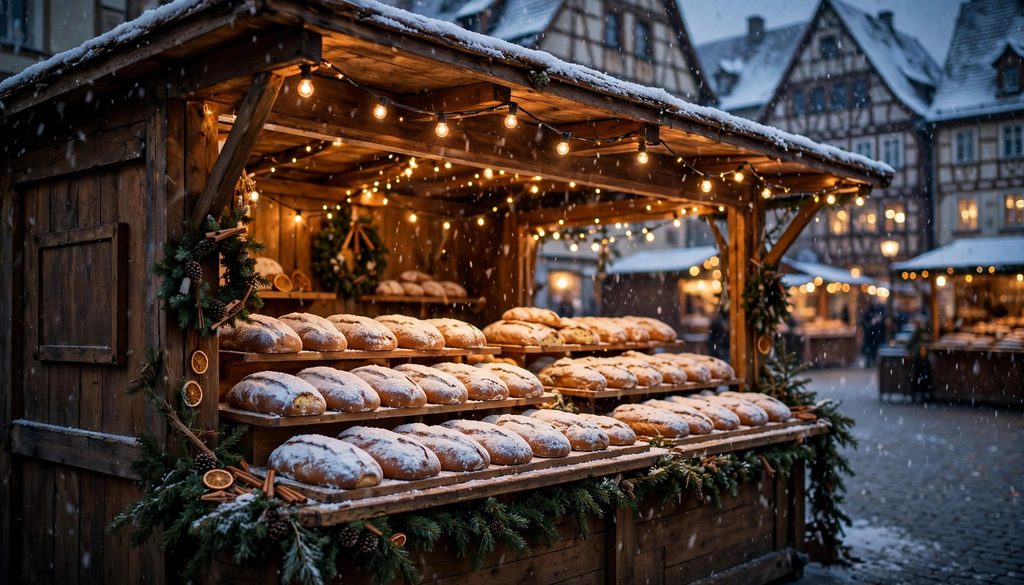
After the Butter Letter, stollen reached royal tables. In 1560, Dresden’s bakers are said to have presented a stollen of about 36 pounds (16 kg) to the Saxon court as a Christmas gift.
Then, in 1730, the story reached its most extravagant scene. Augustus II the Strong, Elector of Saxony and King of Poland, ordered a giant stollen for the festivities of the Zeithain military camp.
It weighed about 1.8 tonnes. Around 100 bakers took part, using 3,600 eggs, 326 churns of milk, and 20 hundredweight of flour. A court architect designed an oversized oven for it, and a special knife about 1.6 metres long was made to cut it. Drawn by eight horses, the finished stollen was served to some 24,000 guests and soldiers.
Dresden still celebrates this moment. Every December, on the Saturday before the second Sunday of Advent, the Stollenfest fills the city: a giant stollen of three to four tonnes is paraded through the streets, then cut and sold. Dresden’s Christmas market, the Striezelmarkt, first held in 1434, is among Germany’s oldest, and its name comes from stollen’s old local name. In Dresden, Christmas arrives in the company of stollen.
The Meaning of Its White Shape
The white, elongated shape of stollen is said to carry a meaning.
Wrapped in its thick coat of powdered sugar, the loaf is said to recall the Christ Child wrapped in swaddling clothes in the manger. That is one reason it feels so fitting for Christmas: the bread carries the story of the Nativity to the table in its very form.
The gentle mound along its centre adds to that impression. It is not only a beautiful shape, but a meaningful one.
Advent: A Bread Eaten While Waiting
The way stollen is eaten sets it apart. It is not only a cake for Christmas Day. There is a pleasure in slicing it little by little through Advent, the season of waiting.
Advent begins about four weeks before Christmas. In those weeks, a household may cut a few thin slices, taste, and wrap the loaf again for the next day. As the days pass, the flavour of the fruit settles deeper into the crumb. Customs vary from region to region and family to family, but this character — a food that keeps company with waiting — is what makes stollen itself.
Waiting is not the same as doing nothing. It is receiving the way things grow, slowly, in time. A stollen is not finished when it leaves the oven. It comes closer to completion in the days that follow.
At TasteTune, we introduce the world’s cuisines together with the time and atmosphere they carry. Inside a single slice of stollen, there are not only 500 years of history, but also a quiet expectation: today is closer to Christmas than yesterday was.
Types of Stollen
Germany recognises several kinds of stollen, with ingredient rules for each. Here are the best-known.
The Dresdner Christstollen is made in and around Dresden from specified ingredients by a defined method. In 2010 it was registered as a Protected Geographical Indication (PGI) in the European Union, and only certified bakeries may use the name. Genuine loaves carry a golden seal showing Augustus the Strong. A true Dresden stollen contains no marzipan.
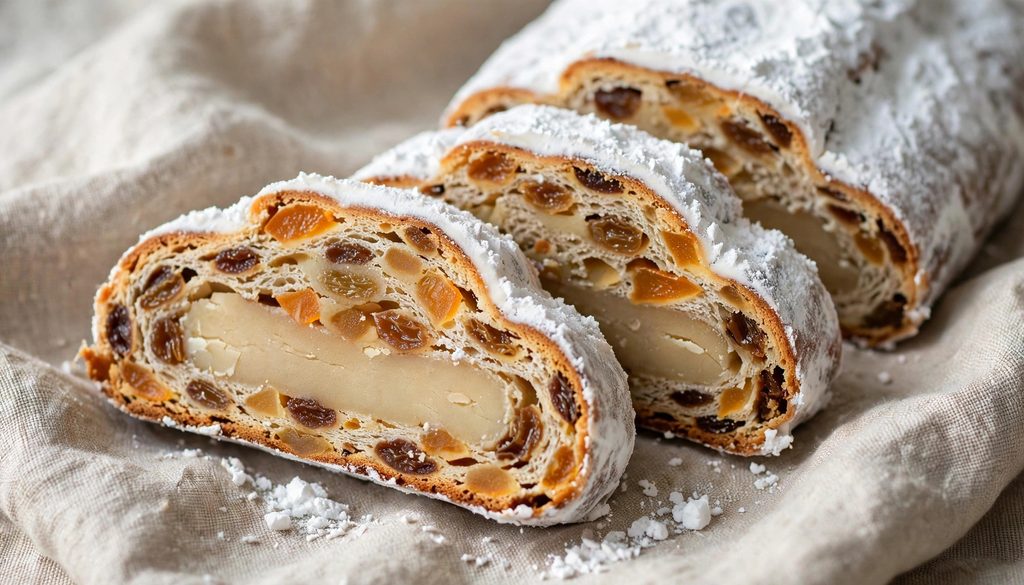
The Butterstollen is the classic butter-rich form. The Marzipanstollen wraps a core of marzipan in the dough, adding a moist sweetness. Beyond these there are the Mohnstollen with poppy-seed filling, the Nussstollen centred on nuts, and the Quarkstollen made with quark, a fresh cheese — each region and bakery with its own character.
Most stollen sold in Japan is the marzipan type. Trying a slice of each kind, and finding your favourite, is part of the fun.
A Home Stollen Recipe
This is not the official Dresden recipe, but a version arranged to be manageable at home. Prepare the rum-soaked fruit the day before.
Makes 1 loaf (about 700g)
About 3 hours (plus soaking and maturing time)
Medium
Contains wheat, dairy, egg, and nuts.
Ingredients
- Mixed dried fruit (raisins, sultanas, cranberries): 200g / soaked in 3 tbsp rum for at least one night
- Candied orange peel: 40g / roughly chopped
- Strong bread flour: 280g
- Ground almonds: 30g
- Granulated sugar: 40g
- Salt: 3g (about 1/2 tsp)
- Instant yeast: 5g
- Warm milk: 100ml
- Egg yolk: 1
- Unsalted butter: 90g / for the dough, at room temperature
- Ground cinnamon: 1 tsp
- Ground cardamom: 1/4 tsp
- Ground nutmeg: a pinch
- Flaked almonds: 30g
- Marzipan: 100g / optional, rolled into a log
- Melted butter: 40g / for finishing
- Granulated sugar: 2 tbsp / for finishing
- Powdered sugar: plenty / for finishing
Steps
- The day before, soak the dried fruit in the rum. On the day, drain lightly.
- Stir the yeast into the warm milk and leave for about 10 minutes.
- In a large bowl, mix the flour, ground almonds, sugar, salt, and spices.
- Add the milk mixture, the egg yolk, and the room-temperature butter. Knead for about 10 minutes, until smooth.
- Cover and let the dough rise in a warm place for about 60 minutes, until roughly doubled.
- Knead in the dried fruit, orange peel, and flaked almonds until evenly distributed.
- Roll the dough into an oval. Place the marzipan along the centre, fold the dough over it slightly off-centre, and shape the loaf so the centre is gently mounded.
- Place on a lined tray, cover, and let it rise again for about 40 minutes.
- Bake in a preheated oven at 180°C (350°F) for 35-40 minutes, until golden.
- While still hot, brush the whole loaf generously with melted butter and sprinkle with granulated sugar.
- Once completely cool, coat thickly with powdered sugar. Wrap tightly in film and foil, and mature in a cool, dark place for at least one week.
- To serve, cut from the centre of the loaf and press the two cut faces back together before wrapping, so the crumb does not dry out.
You can eat it right away, but the flavour settles after about a week. To have it ready for Christmas, bake in late November or early December.
Frequently Asked Questions
When is stollen eaten?
Stollen is eaten during Advent, the weeks before Christmas. From late November, it is sliced little by little and enjoyed through the days leading up to Christmas.
Why is stollen eaten at Christmas?
Because it began as a bread for the Advent fast. Its white shape is also said to recall the Christ Child, which tied it closely to the celebration of Christ’s birth.
How long does stollen keep?
Wrapped in butter and sugar, it keeps longer than most baked goods. Well wrapped and stored in a cool, dark place, about two to three weeks is a good guide. For homemade stollen this depends on ingredients and storage, so enjoy it sooner rather than later.
Why is stollen white?
Because the hot loaf is brushed with butter and coated thickly with powdered sugar. The white coat is said to recall the swaddled Christ Child, and it also helps protect the loaf from drying out.
What is the right way to slice stollen?
Cut from the centre. Take the slices you need from the middle, then press the two remaining halves together cut-face to cut-face and wrap them. This keeps the crumb moist. Slices of about 1 cm are a good thickness.
What is Dresdner Christstollen?
It is stollen made in and around Dresden from specified ingredients by a defined method. It has been registered as an EU Protected Geographical Indication (PGI) since 2010, and certified loaves carry a golden seal of Augustus the Strong.
On Waiting for Christmas
Stollen is not a cake for hurrying Christmas closer. It is a cake for waiting: slicing a little at a time, tasting as you go, and letting the days themselves become part of the celebration.
It began as a fasting bread, gained its richness through a single letter, graced a king’s festival, and is now guarded under the name of its city. Those 500 years are also a story of something growing slowly, in time.
This winter, why not wait for Christmas the stollen way — one small slice at a time? For another German tradition shaped by prayer, see our story of the pretzel. And for more festival breads, read about hot cross buns at Easter and England’s plum cake.
This article is also available in Japanese: シュトーレンはなぜクリスマスに食べる?由来・歴史とドレスデンの伝統、作り方
コメント