

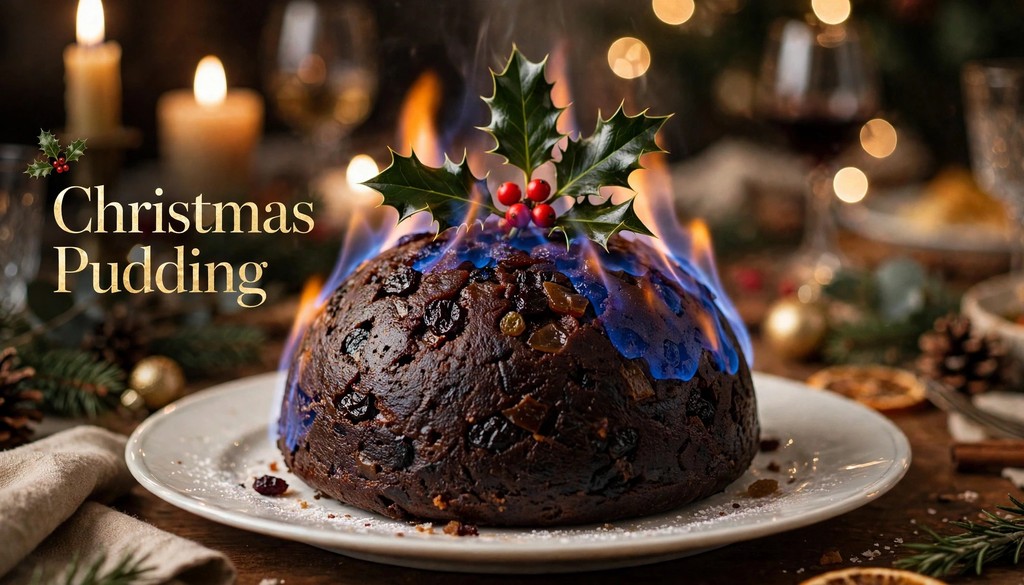
A round, dark pudding arrives at the table wrapped in blue flame — it is one of the most theatrical moments of a British Christmas. Why set a pudding on fire? The short answer: it is a festive flourish, made by pouring warmed brandy over the pudding and lighting it, and its exact origin is unknown. But the pudding’s story begins long before that flame — about a month earlier, when the whole family gathers around one bowl to stir their wishes into it. This article explores the origins and history of Christmas pudding, the tradition of stirring in a wish, and a home-friendly recipe.
What Is Christmas Pudding?
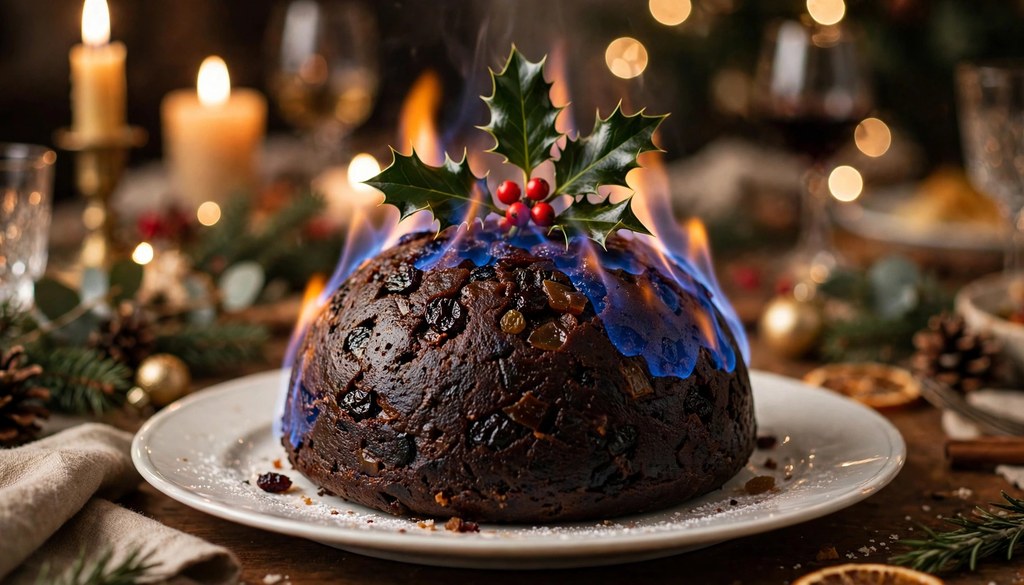
Christmas pudding is a rich, dark steamed pudding from Britain, packed with dried fruit and spices. It is steamed for hours in a domed basin, emerging dense, moist and almost black, with a deep, fragrant flavour.
It has nothing in common with a custard pudding. There is no silky egg custard here: breadcrumbs, flour, dried fruit, sugar and fat are mixed and steamed into something between a cake and a steamed bread. It is also called plum pudding — although it contains no plums at all. The reason lies in its history, as we will see.
Traditionally, the pudding is made about a month before Christmas, left to mature, then steamed again on the day. A sprig of holly goes on top, and some families pour over warmed brandy and set it alight. It is served with brandy butter, custard or cream.
From Plum Pottage to a Christmas Tradition
The pudding’s ancestors are thought to include frumenty, a medieval wheat-and-milk porridge, and plum pottage, a rich stew of meat and dried fruit. In those days, the word “plum” did not mean the fresh stone fruit — it was a general term for raisins and other dried fruit. That is why a plum pudding needs no plums: it is not a mistake or an omission, just an old word that stayed in the name.
By the 17th century, the pottage had become a solid pudding boiled in a cloth, and later it took the shape we know, steamed in a basin. In the 19th century, the name “Christmas pudding” and its recipes settled into cookery books. Queen Victoria and Prince Albert were known to enjoy it, which helped its popularity — although the often-repeated claim that Albert introduced it from Germany has no solid evidence behind it; the pudding existed in Britain long before him.
In 1927 there was even an “Empire Christmas Pudding”: a recipe created by the royal chef using ingredients gathered from across the British Empire — Australian raisins, Canadian flour, Jamaican rum and more — and promoted as a symbol of the imperial table.
Dried fruit sits at the heart of British festive baking. For a baked rather than steamed fruit cake, see our article on plum cake. The two are different sweets, but they share the same naming story: “plum” once meant dried fruit.
Stir-up Sunday — The Day the Family Stirs in Its Wishes
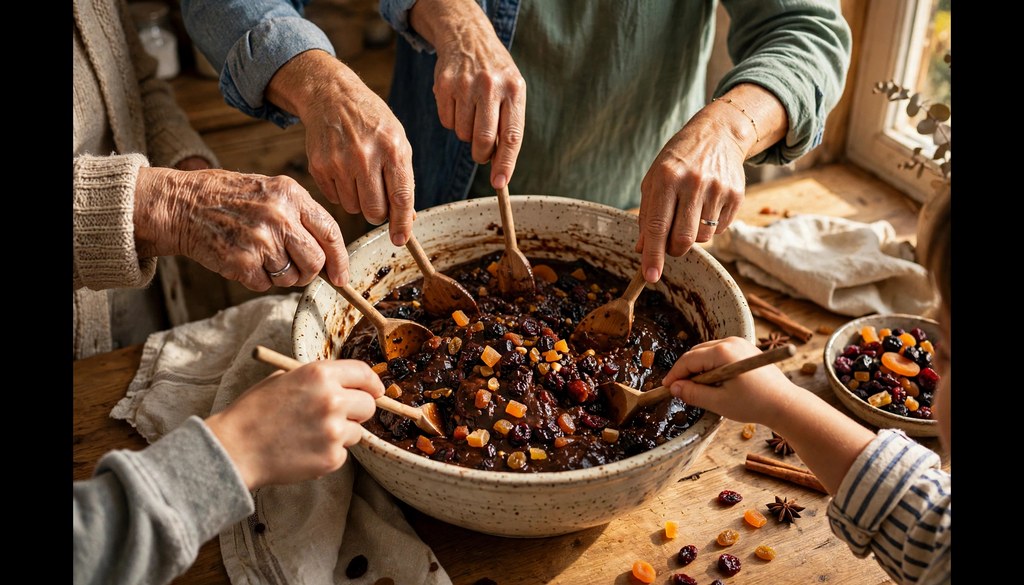
The heart of the pudding’s story is Stir-up Sunday, the Sunday before Advent begins, when the pudding is traditionally made.
The name comes from the words of a church prayer. The collect read in church that day begins “Stir up, we beseech thee, O Lord…” — and in time, the day became known as the Sunday for stirring. It was not created for pudding-making; the link between the prayer and the family custom formed in the Victorian era.
On this day, the whole family takes part. Everyone gathers around the bowl and takes a turn with the wooden spoon, stirring the mixture and making a silent wish. The stirring is said to go from east to west, in honour of the journey of the wise men who followed the star. The wishes need not be grand: good health for the year ahead, smiles for the people we love, and the hope of gathering at this table again next year.
A wish is not something we simply hold on our own. Gathered around one bowl, adding our hopes little by little, they become a single warm moment shared together.
You may come across the claim that the pudding “must” contain 13 ingredients, decreed by the Church. This is a later story with no historical evidence behind it. What matters in this custom is not the number of ingredients, but the time spent stirring together.
The Silver Coin and Other Little Charms
Small charms were sometimes hidden in the mixture. The most famous is a silver coin: whoever found it in their slice was said to receive wealth and good luck.
The coin itself changed over time. For many years a silver threepence was used; after 1937, the sixpence became the standard. Other charms carried their own meanings — a thimble (spinsterhood, or thrift, depending on the telling), a ring (marriage to come), an anchor (safety). None of these was a rule every household followed; they are best enjoyed as traditions passed down in particular families and regions.
Today, coins are best left out: a hidden coin is a choking hazard and can crack a tooth. Our recipe does not include one. Let the story of the lucky coin live on as table talk instead.
The Christmas Table Dickens Described
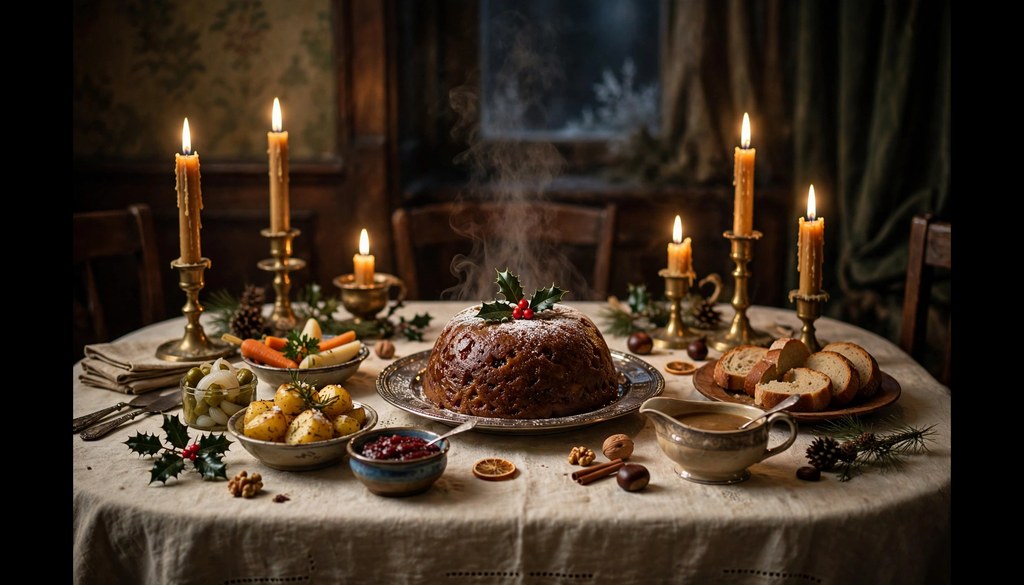
One book fixed the image of Christmas pudding in readers’ minds around the world: Charles Dickens’ “A Christmas Carol” of 1843.
At the climax, the poor Cratchit family’s Christmas dinner is crowned by a steaming pudding, carried in with ceremony — the family’s one great festive dish of the year. Dickens did not invent the pudding. He took a tradition already alive in British homes and portrayed it, memorably, as the symbol of a family’s celebration.
In the years that followed, the flaming round pudding appeared again and again in illustrations and cards as the very picture of a British Christmas. Literature and art helped that image travel the world.
Served in Flame
On Christmas Day, the matured pudding is steamed again for about two hours, until heated through. It is turned out onto a plate and crowned with a sprig of holly — a plant long associated with Christmas as a reminder of the crown of thorns. Its berries are poisonous, though, so if you use holly as a decoration, keep it from touching the food that will be eaten.
Then comes the flame. Brandy is warmed in a small pan — never poured straight from the bottle over a flame — then ladled over the pudding and lit. A blue flame wraps the pudding for a few seconds and dies away. It is a flourish for the climax of the meal rather than a step that changes the flavour, and where the custom began is not clearly known.
If you try it at home, keep anything flammable well away and keep children at a distance. There is no obligation to flame the pudding at all; served plain with brandy butter or warm custard, it is every bit as traditional and delicious.
A Home-Friendly Christmas Pudding Recipe
The traditional fat is suet, the hard fat from around beef kidneys, which is difficult to find in many countries. This recipe uses grated chilled butter instead — a method used by modern British recipes (including the BBC’s) — with the mixture balanced for butter from the start. It makes one pudding of about 8 servings in a 1.2-litre (2-pint) heatproof basin.
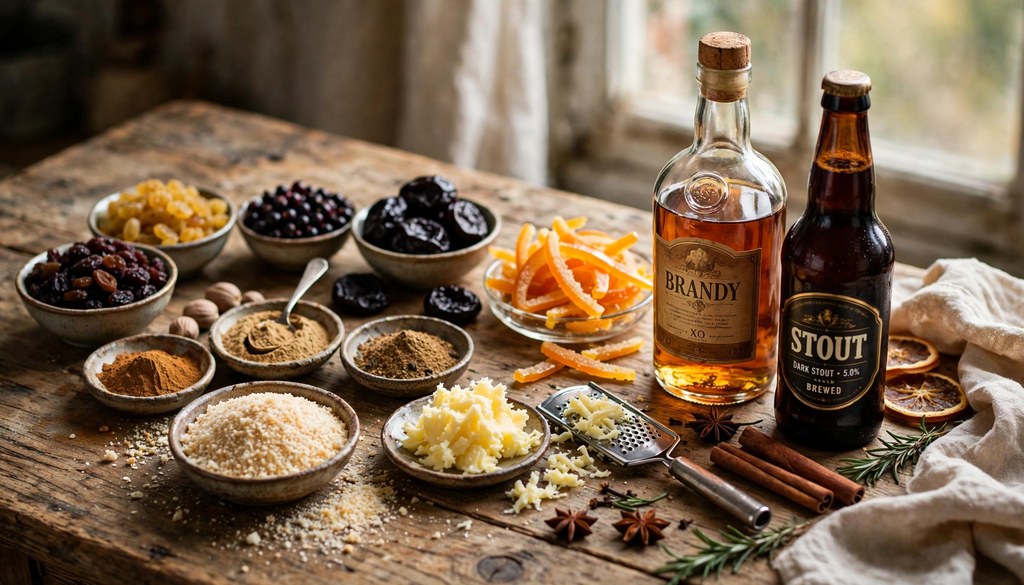
Ingredients (1.2-litre basin, about 8 servings)
- Mixed dried fruit (raisins, sultanas, currants) 350 g
- Prunes, roughly chopped 100 g
- Dark brown sugar 100 g
- Fresh white breadcrumbs 100 g
- Plain flour 50 g
- Ground almonds 50 g
- Walnuts, chopped 50 g
- Butter, frozen and grated 100 g
- Eggs 3
- Rum or brandy 4 tablespoons
- Stout 100 ml (or strong black tea or apple juice)
- Mixed spice 2 teaspoons (or cinnamon 1 tsp + nutmeg 1/2 tsp + a pinch of allspice)
- Ground cinnamon 1 teaspoon
- Ground nutmeg 1/2 teaspoon
- Grated zest of 1 orange
- A pinch of salt
Method
1. The day before, pour the rum (or brandy) and stout over the dried fruit and prunes, cover and leave overnight. If you are short of time, warm the mixture briefly in the microwave and rest it for 30 minutes instead.
2. In a large bowl, mix the breadcrumbs, flour, sugar, ground almonds, spices and salt. Add the grated butter, walnuts and orange zest.
3. Add the beaten eggs and the fruit with all its soaking liquid, and stir everything together well. This is the Stir-up moment: let everyone in the family take a turn and make a wish.
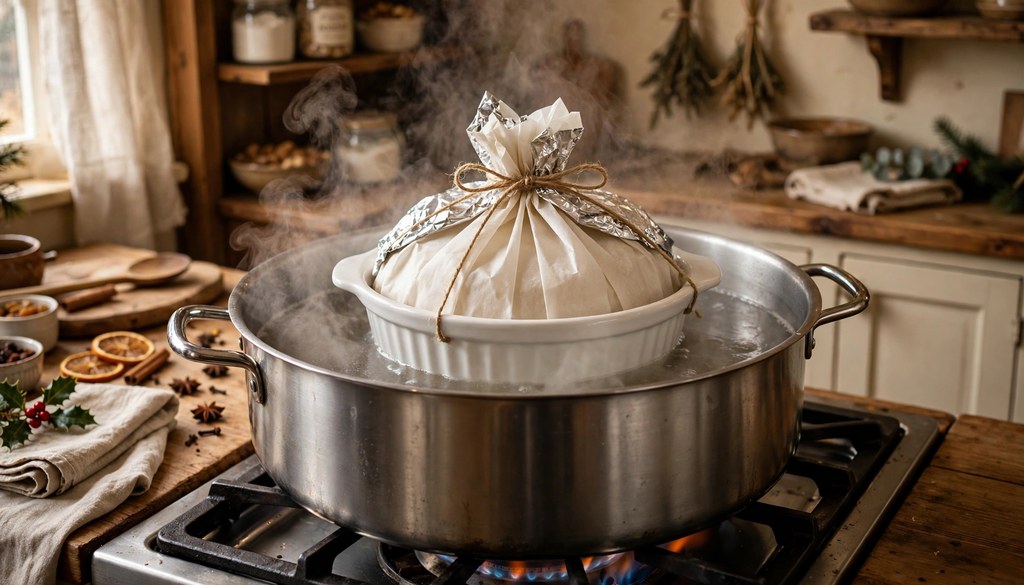
4. Spoon the mixture into a buttered heatproof basin and level the top. Cover with a double layer of baking parchment, then foil, and tie securely with string, making a string handle.
5. Steam over gently simmering water for 6 hours. Check the water level as it cooks and top up only with boiling water.
Keep the steamer topped up — never let it boil dry. Always add boiling water, not cold, so the temperature stays steady.
6. Let the pudding cool, then replace the covers with fresh parchment and foil. Store in the fridge and rest it for at least a week so the flavours settle. If you like, spoon a tablespoon of brandy over the top once a week.
7. On the day, steam again for 2 hours until heated through. Turn out onto a plate and serve with brandy butter or custard. If you flame it, warm the brandy in a small pan first, pour it over, and light it — with everything flammable well away.
For this home recipe, keep storage simple and safe: up to 1 month in the fridge, or 3 months in the freezer. Traditional puddings are famous for maturing over months, but refrigeration is the sensible rule for a home kitchen. Slices also reheat beautifully in the microwave.
Frequently Asked Questions
Q1. What is Christmas pudding?
A traditional British steamed pudding of dried fruit, breadcrumbs and spices, steamed for hours in a basin and steamed again on Christmas Day. It is entirely different from a custard pudding.
Q2. Why is it eaten at Christmas?
It descends from medieval festive dishes and became established as the Christmas centrepiece in the 19th century. The custom of making it a month ahead, and Dickens’ famous description, made it a symbol of the British Christmas.
Q3. Why is it set alight?
Pouring warmed brandy over the pudding and lighting it is a festive flourish. Its exact origin is unknown; descriptions of the flaming pudding appear in records and literature from the 19th century onwards. There is no need to do it at home.
Q4. What is Stir-up Sunday?
The Sunday before Advent, traditionally the day to make the pudding. The name comes from the church collect beginning “Stir up, we beseech thee…”. Families stir the mixture together, each person making a wish.
Q5. Why is it called plum pudding?
Because in older English, “plum” was a general word for raisins and other dried fruit. The name kept the old word; the pudding was never required to contain fresh plums.
Q6. What is the difference between Christmas pudding and plum cake?
A pudding is steamed in a basin and is moist and dense; a plum cake is a baked fruit cake. They differ in method and texture, but share the same naming story — “plum” meaning dried fruit.
Q7. Can I make it without suet?
Yes. This recipe uses grated chilled butter, as many modern British recipes do. The texture differs slightly from a suet pudding, but the flavour is rich and fragrant.
Q8. How far ahead can I make it, and how do I store it?
Traditionally it is made about a month ahead, on Stir-up Sunday. For this home recipe, store it up to 1 month in the fridge or 3 months in the freezer, and steam it again for 2 hours on the day.
Q9. How is it different from stollen or panettone?
All are made in the season of waiting for Christmas, but each has its own heart: stollen is about waiting, panettone about inheriting, bûche de Noël about gathering around the light, and gingerbread about making joy by hand. Christmas pudding is the one where the whole family stirs its wishes into a single bowl.
In Closing
Into one pudding, many wishes. What is carried to the Christmas table may be more than a dessert — it may be the small memories of the people who made it together.
The time spent around one bowl, taking turns with the spoon, is as much a part of this pudding as its flavour. This Christmas, why not pass the spoon around your own table, and let everyone’s wishes layer into one pudding?
日本語版はこちら:クリスマスプディングはなぜ燃やす?イギリスの由来・歴史と願いを込める伝統、作り方
▶ See the Christmas roundup: Christmas Flavours of the World: From Stollen to Eggnog — Six Stories of the Season’s Table

Comments